


Risk management and liquidity are required in order to meet the global trade rebound, writes ETIENNE BERNARD (left), head of Global Transaction services eurozone & Middle East, and NICOLETTA STELLA, Middle East strategy, Global Transaction services Middle East at RBS.
While there are indications that the worst of the credit crisis may be behind us, it is generally thought that global trade will rebound, driven first by restocking inventory needs and then by the recovery of consumer spending. further proof of this came last December, which brought signs of improvement in the job market (us unemployment data), giving hope to a gradual recovery of consumer spending. In the medium to long term, consumer spending is the key factor influencing the rebound of global trade.
Inevitably, the rebound will not be uniform, with certain regions seeing growth sooner than others. unquestionably, the economic environment has changed dramatically and the credit crisis has sharpened the need for tighter risk management around the globe, and this also holds true here in the Middle east. Liquidity, previously abundant in the region, will be priced at a premium in the short and medium term, meaning that businesses need to select trade banks that can adapt and provide solutions for both.
This article examines current global trade trends and how corporates and financial institutions in the Middle East region could be in a fortuitous position when it comes to taking advantage of the growth cycle and the coming trade rebound.
The credit crisis
In order to understand what the next year may hold, we should first review what happened to global trade over the past 18 months, and where we stand at present.
The baltic dry Index shows how the price for a container dropped by 90% between june 2008 (historically the highest point) and November 2008 (recent lowest point). empty container ships circled the world’s trading ports, while many companies that had never felt the need to use trade insurance or finance tools were forced to close. It is estimated that more than 20,000 SMEs in China alone went out of business during the peak of the crisis.
So with asset prices falling, capital markets drying up and corporate credit risk rising, banks and insurers struggled to provide the financing and guarantees required to support even subdued levels of trade.
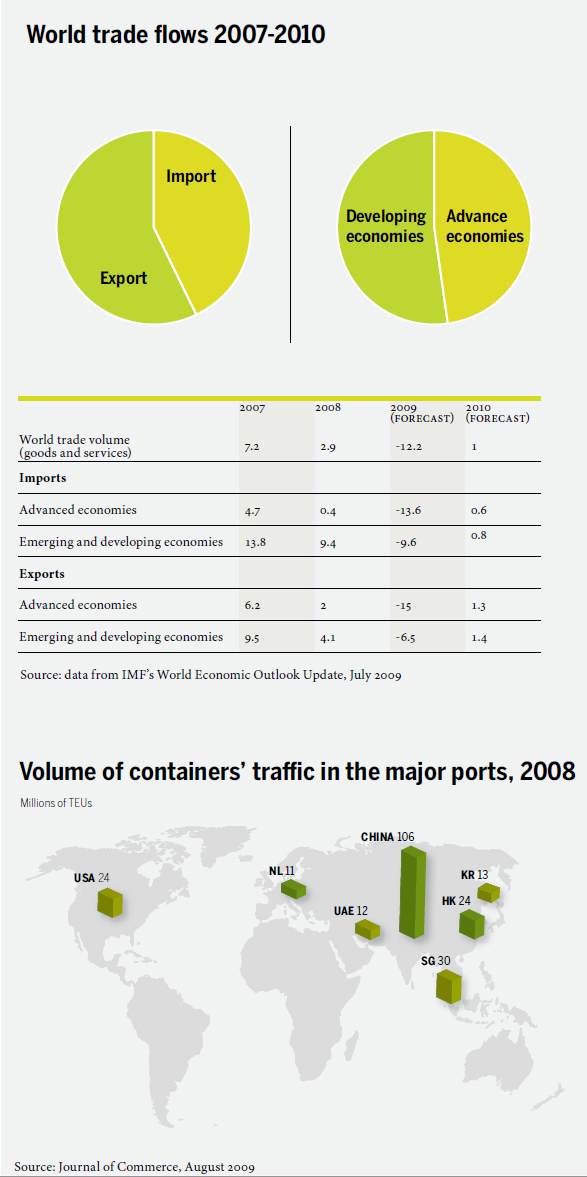
But as 2010 unfurls, the world economy is slowly stabilising, helped by unprecedented macroeconomic and financial policy support. even if the recession is not over, the latest Imf estimates (June 2009) indicate that the global economy will expand by 2.5% in 2010 (up from -1.4% in 2009). It is also worth noting that these forecasts have improved with respect to earlier estimates from the IMF.
Early signs of the trade rebound are also seen in the same baltic dry Index. In 2009 the index regained some of the earlier losses, rising up to 5,000 points, i.e. quadrupling its lowest point.
Will the rebound continue at this speed? The IMF forecasts a modest growth of 1% in 2010, up from a scary 12.2% drop in 2009. The picture for trade volume growth is not uniform and it shows how emerging export economies will enjoy the largest slice of the cake (see tables, below).

The Middle East’s role in the global trade rebound
With the majority of the population of the Middle East clustered on the coasts, marine trade has always been pivotal to the region’s economies. since the opening of the suez Canal in 1869, the region has also been a key staging post on the trade routes between east and west. We are seeing the Middle East as an increasingly important trading partner for Asia, and in particular China. Indeed, a recently published book on this subject, The New Silk Road, notes trade volumes between China and the Middle East have increased to levels higher than those between China and the us.
There are several tangible and intangible indicators that highlight the shift in global trade patterns towards this region. One tangible indicator is the increased volume of container shipping through dubai’s port of jebel ali. In the diagram on the previous page, we analysed data published by the Journal of Commerce (august 2009) on worldwide container traffic. The report showed that in 2008, jebel ali became the world’s sixth largest container port, overtaking rotterdam, the largest port in europe.
Competition for the transshipment market from the Arabian Peninsula is the main intangible indicator: currently there are new ports expanding, opening or under construction in every Gulf Cooperation Council (GCC) state, often linked with conveniently located ‘free-zones’.
The global downturn has reduced traffic through the region’s ports. however, the economic diversification policies of the Gulf states are helping to increase domestic demand, while buoyant, forwardlooking infrastructure investments are ensuring that the region is fully geared to reap the growth of trade business as it arises.
This begs the question of how corporates and financial institutions can reap the benefits of the future growth of trade in the Middle East? The key words, in our view, are risk management and liquidity.
Managing risk effectively
In a world of higher risk, certainty is of greater value and it has become a priority in the region. We are seeing an increased use of traditional trade finance instruments such as (Confirmed) Letters of Credit (L/Cs), replacing to a greater extent ‘open account’ settlements. These instruments may very well be as old as the ancient silk routes, but the principle remains the same: it is the bank, not the buyer, who guarantees payment. The supplier can exchange its L/C for cash well before the settlement date, improving cash flow and allowing it to fund production of the next order.
Supporting suppliers has become a key trend simply because, as supply chains crumbled in the aftermath of the credit crisis, buyers discovered just how important they were. Without the right parts, raw materials or finished goods, how can the corporate buyer generate profit? In this environment, L/Cs have thus become a crucial way for companies to maintain strong relationships with their most important suppliers, and consequently, a way to manage trade risk more effectively.
Some banks can do more to support corporates in strengthening their supply chain. by leveraging the buyer’s credit rating, banks can offer a range of solutions to address liquidity challenges at the same time. supply chain finance programmes effectively see both sides of a fundamental commercial issue – addressing not only the goal of the buyer to pay as late as possible, but also the supplier’s need to receive payment as early as possible.
By entering into a supply chain finance (SCF) facility with a bank experienced in this class of product, buyers can negotiate extended payment terms, while suppliers get the option to receive early payment from the bank at a discounted rate. The buyer increases its days payable outstanding (DPO) with participating suppliers and, in doing so, improves its working capital position. suppliers can do the same, reducing their days sales outstanding (DSO) by selling their invoices to the bank. recently, we have witnessed increasing interest for this type of financing solution in the region.
The reason for this is simple: the supply chain as a whole is impacted positively by limiting any disruption of the manufacturing line and giving the buyer the chance to support key suppliers with much-needed liquidity. suppliers, meanwhile, get access to a reliable source of competitively priced, off-balance sheet, on-demand funding – based on their buyer’s credit rating – which is typically more cost-effective than applying for a line of credit themselves.
Another important benefit of SCF programmes is improved visibility and control of cash flow provided by electronic banking platforms.
Typically, suppliers can log on to an online view of their trading account with the buyer – including invoices, debit notes, remittance advice and payment dates. This data can then be seamlessly integrated with other banking systems to enable companies to automatically manage their liquidity structures and payment processes.
Consequently, since access to (and cost of) capital is still an issue for corporates and their suppliers, many find that trade finance can offer a strong route to liquidity in the current environment. additionally, from a bank perspective, making a specific trade-related loan makes good sense as it typically requires a lower capital allocation than other loan types. This, in turn, makes finance cheaper and more easily available for corporates.
Visibility at the global level
Although larger facilities and standardised processes may be high on corporate wish lists, the reality is that many companies will increasingly be funded by more than one bank – and won’t have the capacity or appetite to invest in new infrastructure.
The demand for cost-effective solutions that enable visibility of trade flows at the multibank level, has therefore led to an increased use of sophisticated platforms developed in-house by the leading banks in this sector.
For example, at RBS we have developed solutions that address the clients’ funding needs regardless of the technology solution they choose. This flexibility means that companies can integrate cash management, trade and payment processing capabilities into their existing frontand back-office systems with minimal disruption to their processes or supply chain. We are comfortable utilising a number of platforms, whether our own proprietary solutions, third-party or client-owned systems, and believe this gives us an enhanced ability to meet our clients’ needs.
Finally, visibility and risk management at the global level can be best achieved by working with a trade bank present in the main trading economies worldwide, or which can access strongly rated partner banks at a local level. as a leading global trade finance provider, the RBS network covers over 90% of global trade flows and we can provide a comprehensive range of product capabilities that cover financing from debt to equity, and risk management from FX to commodities hedging.
Increasing prominence
Working together, corporates and financial institutions are ideally positioned to take advantage of the upcoming growth of trade business, which will see the Middle East take an increasingly prominent position on the global map. but in order for this growth to be sustainable, risk must be tightly managed and liquidity must remain available and accessible in the long term.
The choice of a global banking partner with consolidated trade finance experience may be the determining success factor.