

The changing technology landscape for commercial banks has been ever so intriguing with the rapid evolution of block chain applications; Rahul Jayakar tries to demystify some of the trends in the times to come.
Drive for Efficiency
Banks have been opportunistic in terms of creating various profit centers at every stage of the payment transaction. Over a period this has resulted in building of a multiple touch point sequential payment model. This model is supported by SWIFT’s messaging system which is the backbone for banks payment network globally. This model served well at a time when few outside the banking industry knew the cost and speed inefficiency.
Let’s take the simple case of cross border funds payment; there are no less than 5 touch points within and outside the bank before the transaction is executed. In a simple sequence of events it will be the payments/ remittance team, the treasury/FX team, correspondent bank, beneficiary bank which again may have a couple of touch points before the transaction finally gets settled. Every stage has a fee chargeable, some visible some not. Each hand-off in the chain adds to the processing time which is further augmented with the mandatory compliance screening required due to growing regulatory requirements
2008 financial crisis put an emphasis on transparency, speed and cost. It became apparent there was a need to overhaul the sequential payment model. The internal processes coupled with regulatory checks have made it imperative that banks need to innovate. The innovation journey at banks end especially on the commercial banking side of business has been slow.
Limited applicability solutions
In the last decade, we have seen solutions coming up to resolve the cost issue. Multinational (MNC) banks which had large network came up with global accounts, which meant clients could do multicurrency transactions through a single global account. This solution, enabled clients to settle the cross border payments finally in the beneficiary countries local clearing, unlike the USD settlement. This concept is taken forward by some Fintech companies, which managed to utilize the solution for consumers hence applying the same for a wider clientele than what banks offered. While the solution addressed the cost impact, still did not solve some issues like security and speed.
Another payment solution provided by Fintech companies, money service bureau’s was through e-wallets, cards giving clients a slightly better customer experience, however it still lacked the trust and speed; one of the key reasons was that it was still using the old infrastructure
Technology disruption – Blockchain
The evolution of blockchain (distributed ledger) technology in past couple of years has opened the possibility of alternate payment infrastructure. Blockchain will change the entire landscape in terms providing the technology not just for payments but has a promise to do much more, trade, trade contracts, underlying documents, FX, derivative contracts, bonds, commodities and many more areas. The table lists the potential use cases:
| Application | Implication |
| Trade | – Blockchain ability to provide smart contracts can be replicated for Letter of credits
– Greater use of e-documents – Since the system will be rule based, time taken for scrutiny will reduce substantially; will also eliminate need for document checkers |
| Risk distribution | – Will eliminate the need manual coordination for asset/risk to be distributed; Risk/asset can be hosted on the network, where interested investor can bid for the same.
– Master risk participation agreement can be executed through smart contracts |
Existing Players
During 2015 SIBOS, RIPPLE garnered attention with the launch of its commercial solution using distributed financial technology (blockchain) which allows banks to directly transact with other banks in real time. An alternative to today’s global payment infrastructure, Ripple eliminates time delays and ensures certainty of settlement, resulting in lower transaction costs for banks and their customers. The solution is aimed at addressing all the three pain points’ transparency, speed and cost
Forward thinking Financial Institutions are participating in the exploration of the blockchain technology in one of the following ways:
- By holding “Blockchain Hackathon” whereas they are inviting Fintech’ s/start-ups to present solutions for commercial business problems which are then evaluated and niche ones selected for Proof Of Concept (POC).
- Participants in the financial space are coming together to form consortiums. R3CEV was the first to form with a group of 15 banks which has grown to 70 as of Dec 20161, Ripple formed the global payments steering group soon after being the partner of choice for the Japanese consortium of banks2. There is also the Schengen consortium which was formed at the middle of this year. The positive part is that most of the consortiums or groups are also in discussion or have atleast one regulatory body as a part of their respective group.
- Private networks is another trend where banks or fintechs though are member of a group or consortium are forming a private distributed ledger especially to come up with solutions for smart contracts, trade finance and supply chain finance
Regulator in every market is interested to be a part of action either by encouraging the digitization initiative or regulating it. The government in Dubai has gone a step ahead by launching the blockchain strategy to become paperless by 2020. Central banks in some of the more forward looking countries have already started work around using the technology for local clearing.
Dubai International Financial Centre (DIFC) has contracted with Accenture to set up and operate a fintech accelerator for regional and international startups. Dubbed FinTech Hive, the project will invite startups to compete for entry into a 12-week accelerator programme, offering the winners the opportunity to develop, test and modify their innovations in collaboration with top executives from DIFC and regional financial institutions. Emirates NBD and Mashreq will be the first local financial institutions to join the accelerator programme, while HSBC and Visa have been lined up as the first international financial services providers3.
For blockchain to achieve the scale, it needs market participants to adopt and adapt to the technology quickly because transactions can be executed successfully, if both nodes (remitting institution and the beneficiary’s institution) have the technology.
New Solutions
In the beginning of 2016 SWIFT announced the launch GPI program (Global Payments Innovation), an SLA based program to improve transparency, speed and cost on the existing Payment Model. This was the first attempt by SWIFT to catch on to the growing demand for innovation in the payment space
However interesting news came in on 24th November 2016 when SWIFT unveiled its Proof Of Concept (POC) for blockchain technology at the interbank co-operative’s European Operations Forum in Berlin. The POC emerged from Swift’s new R&D division, which has been quietly exploring the technological possibilities of distributed ledgers. As part of this, the co-operative ran a blockchain challenge in April looking at potential use cases for the technology and expects to see a number of other POCs come to fruition in Q1 2017.
It’s perhaps a significant step in the right direction by SWIFT because it connects over 10,000 financial institutions spread over 200 countries4. SWIFT with its already established membership network can get the much required connectivity across service providers and also set the standards for linking up blockchain, which is missing at the moment.
In conclusion
As blockchain continues to evolve and newer applications are discovered; the solutions look like polka dots of technology, all with different colour, shapes and sizes. The need for industry bodies to work closely in order to build standards for similar applications becomes imperative, making the entire ecosystem efficient.
This trend certainly is exciting with so many established and new players entering, each one showcasing their application; makes it a space to be watched out for in 2017.
References:
1 – Source: www.r3cev.com
2 – Source: https://www.swift.com/about-us/history
3 – Source: www.fintechhive.difc.ae
4 – Source: ripple.com
Biography – Rahul Jayakar
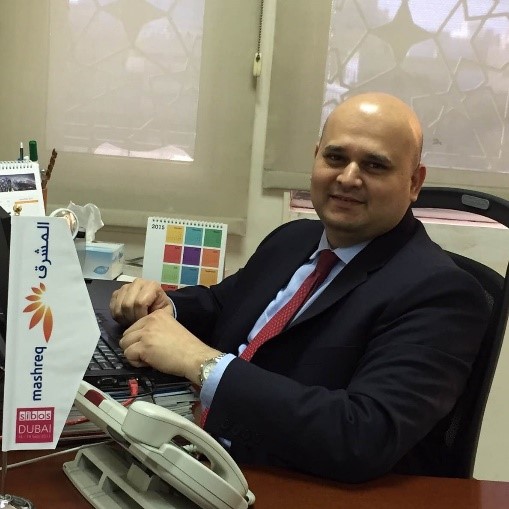
Rahul Jayakar is an experienced banking professional having worked in large multinational and regional financial institutions in the UAE and India.
Rahul Jayakar was named by Global Finance in its list of Who’s Who in Treasury & Cash Management Oct 2016. Global Finance stated ‘The individuals that we honour in Global Finance’s Who’s Who in Treasury and Cash Management are those that have been recognized as best in their field by their peers and colleagues, and by our own Editorial Board. They are well equipped to successfully chart a course through these unknown waters.’
Currently, Rahul heads Mashreq’s Global Transaction Services, products and Trade; he has primary accountability for developing the Bank’s transaction banking business. Prior to the current role Rahul was responsible for the Mashreq’s transaction banking business outside the UAE, in 11 countries and Financial Institutions.
Prior to Mashreq, Rahul was with Standard Chartered Bank (SCB), since 2005; his last role was senior Transaction Banker in Strategic Client Coverage Group, Wholesale Banking; where he covered top 5 Indian corporate groups globally for their transaction banking requirements.
Prior to SCB, Rahul has worked with private banks in India in wholesale banking in variety of roles in coverage, sales and products, which included, Relationship Management, Asset Distribution, Trade Finance, Supply Chain Finance & Cash management.
Rahul is a Bachelor of Science (Physics & Electronic) from National College (Mumbai University), India, completed MBA from Sydenham Institute of Management Studies (Mumbai University).