
100 senior industry leaders participate in high-level discussions at the World Takaful Conference: Asia Leaders Summit (WTC: ALS 2012)
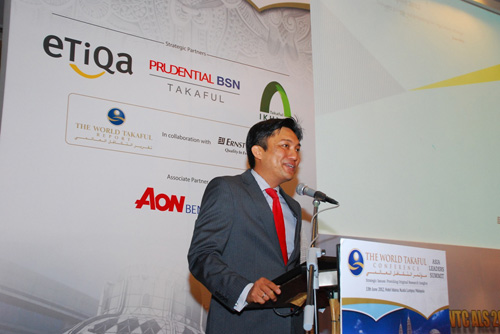
Kuala Lumpur, Malaysia, 13th June 2012: The World Takaful Conference: Asia Leaders Summit (WTC: ALS 2012), which opened today at Hotel Istana, Kuala Lumpur, saw more than 100 senior executive industry leaders in the regional Takaful industry engage in critical discussions on strategies for competing for growth in an increasingly competitive Asian Takaful market. The event, which builds on the on the successful 7 years history of the World Takaful Conference: Global Summit, held annually in Dubai, outlined the big picture industry changing scenarios and discussed the critical issues facing the regional Takaful industry.
Speaking to the media present at the event, David McLean, Chief Executive of the World Takaful Conference noted that “the global Takaful industry has witnessed tremendous growth in the last decade, rapidly becoming an integral part of the mainstream financial system and South East Asia, particularly Malaysia, has been the nerve centre of this dynamic and vibrant industry. According to a recent report by Bank Negara Malaysia, the Takaful industry experienced a compounded average growth rate of 27 percent in terms of net contributions between 2005 and 2010. Given the large untapped market that still exists, the Takaful industry in Malaysia is poised to benefit in the years ahead on the back of steady demand. Similarly other key markets in South East Asia such as Indonesia and Brunei are also rapidly emerging as important Takaful markets.”
He also said that “the World Takaful Conference: Asia Leaders Summit, which is the latest addition to our portfolio of flagship industry events, is set to continue our tradition of supporting growth, excellence and innovation in the global Takaful industry which first began with the launch of the World Takaful Conference in Dubai 7 years ago. With its unique format, which uniquely utilizes the latest research from the recently released 2012 edition of the Ernst & Young World Takaful Report as the foundation for strategic debate between industry leaders, WTC: ALS, in its first year itself, has already established its position on the annual calendar as an important strategic gathering for regional industry leaders to discuss and debate the future of the Shari’ah-compliant insurance industry.”
The World Takaful Conference: Asia Leaders Summit (WTC: ALS 2012) was inaugurated with a highly interactive opening session led by Brandon Bruce Sta Maria, Partner, Assurance – Insurance Leader, Ernst & Young Malaysia. The session provided an overview of the findings of the Ernst & Young World Takaful Report 2012, which was launched at the 7th Annual World Takaful Conference: Global Summit in Dubai this April, and analyzed its strategic implications for Takaful players in Asia. The session also assessed key global developments and their impact on the Takaful industry in Asia.
Speaking on the sidelines of the event, Brandon Bruce Sta Maria noted that “global Takaful contributions grew by 19% to US$8.3b in 2010. Of these, the GCC contributed US$5.68 bn and South East Asia contributions were US$ 2 bn. In 2010, growth in the GCC slowed to 16%, from a compounded annual growth rate (CAGR) of 41% in 2005-2009, as the implementation of compulsory medical Takaful in Abu Dhabi and Saudi Arabia was completed earlier. Saudi Arabia remains by far the largest Takaful market, contributing US$4.3b or 51.8% of the industry at an average contribution per operator of US$141m.”
He also said that “Malaysia grew 24% to reach contributions of US$1.4b at an average contribution per operator of US$141m. With current growth trends, and the addition of new frontier markets such as Indonesia and Bangladesh, it is expected that gross contributions will reach US$12b by 2012. By contrast, the GCC Takaful market predominantly comprises of general Takaful business with family Takaful accounting for as little as 5% in certain markets.”
“Strong competition, evolving regulations and shortage of Takaful expertise are identified as key risks in both the GCC and South East Asia. Young Takaful operators are relying upon aggressive pricing strategies to compete against the established, older, conventional players. Such pricing is not sustainable and causing significant pressure on the industry’s profitability. There are increasingly stringent regulatory requirements on capital and solvency, indicating the regulators’ desired future direction”, he added.
A similar view was expressed by Zainurin Julaihi, Senior Vice President and Chief Financial Officer of Takaful Ikhlas Sdn Bhd who said that “with a track record of sustained double-digit growth rates, the potential for the Takaful industry in Asia is unquestionable. The low insurance penetration, demographic factors and the rise in Shari’ah compliance awareness have made the region an attractive destination for both domestic providers as well as global conventional insurers entering the Takaful market space.”
He also said that “though the focus has shifted towards identifying strategies to translate the market potential to real growth, industry leaders must also keep a constant check on the increasing competitive pressures and the challenges that come along with it.”
1 Comment
Strong Competition, Evolving Regulations and the Shortage of Takaful Expertise Identified as Key Risks in both the GCC http://t.co/vn4LKoZz
Strong Competition, Evolving Regulations and the Shortage of Takaful Expertise Identified as Key Risks in both the GCC http://t.co/vn4LKoZz