
Monday 30th September 2013
- Invesco launches Global Sovereign Investor Model – a framework for understanding sovereign investor investment objectives and preferences
- Global development sovereigns expected to take lead from Asia and drive local development through international commercial partnerships
- Huge potential in Middle East, Asia and Emerging Markets from the shift in asset allocation towards alternatives
 Invesco today released its first Invesco Global Sovereign Asset Management Study1, an in-depth report which offers insight into the complex investment behaviour of sovereign investors across the globe.
The unique study, which provides a framework to help understand the investment preferences and strategy of these funds, shows that the biggest growth story among global sovereigns today is an increase in a so-called ‘public-private partnership’ investment approach. An approach, which sees commercially minded sovereigns seeking direct strategic investment in private companies to support GDP, job creation and skills transfer.
The ‘Invesco Global Sovereign Investor Model’ is an evolution from the framework developed in Invesco’s Middle East Asset Management Study2, which is now in its fourth year. It acknowledges the diversity among sovereign investors, and that each has many aspects influencing investment strategy such as region, size, environment and most importantly, investment objective.
Currently global sovereign flows represent just over US$6 trillion3, a vast market which major global economies rely on for investment. Understanding how and why these assets are being invested is therefore vital for global economies courting these sovereigns.
The Invesco Global Sovereign Investor Model bases its segmentation on investment objectives and outlines four key profiles:
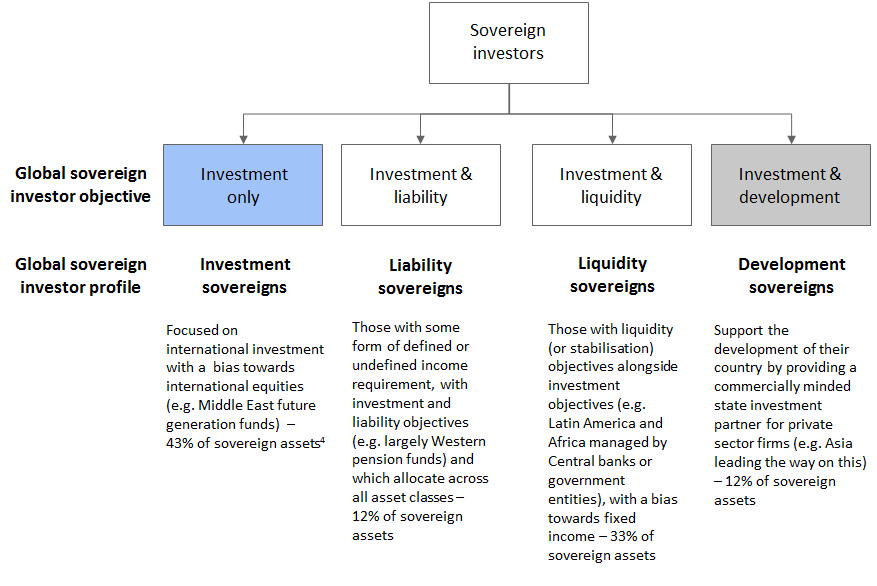
Source: Invesco Global Sovereign Asset Management Study 2013
4 Based on the sample of 37 global sovereign investors
Nick Tolchard, Co-Chair of Invesco’s Global Sovereign Group & Head of Invesco Middle East, said: “There is a ‘public’ perception that these vast global sovereign wealth funds invest heavily in international strategic or trophy assets, and are seeking big stakes in other countries, however this is not always the case. For many their first objective is focusing on the home market and developing the local economy. If sovereigns think they will get a better return locally, they will invest locally. In the main, international investments are made to provide diversification.”
Sovereign investors with local development objectives – a global phenomenon?
While investment sovereign investors have the greatest funds under management, the study suggests that it is ‘development’ sovereigns which are most likely to grow in numbers over the next few years, with surplus funds being invested for local development objectives through commercial partnerships with private firms. We have seen development funds being set up in the Middle East and more are in the planning in regions such as Latin America.
This ‘direct strategic investing’5 is being seen by sovereigns who have the capital but lack the expertise, as an opportunity to acquire skills and build relationships with international partners. It is also a way for private companies to expand internationally by exporting their skills to these countries.
The success that Asian development funds have shown by being activist in this way and establishing competitive advantage in key sectors to support the development of their country has been recognised around the globe. Middle East and Western respondents were quick to identify them as leaders in terms of performance, track record and capability and are seeking to replicate them. It was viewed that Asian development funds largely focus on the manufacturing sector and initial signs suggest that the service sector will be more popular for new development funds in the Middle East and the West. Sectors are selected based on areas where funds can add value and help the private sector build sustainable businesses. As a result, sectors will vary depending on the capabilities of the individual nation.
Nick Tolchard said: “Our study informs us that many more countries plan to set up similar funds using surplus capital for private partnerships, which makes them of particular interest. We believe there could be an investment case for every country, irrespective of development phase, to set up a development sovereign to facilitate private investment via a commercially minded state investment vehicle. This is more prevalent in Asia, where the sovereigns are highly active in this way. The question will then be around how activist in nature will other sovereigns be?”
Significant shift in allocations to alternatives expected to drive returns
Put off by high volatility in equities and a low interest rate environment challenging fixed income returns, investment sovereigns (including ‘Liability’ and ‘Liquidity’) have been heavily shifting their allocation to alternatives and away from core asset classes. For example, over two thirds (69%) of sovereign investors cited growth in international real estate while 61% cited growth in international private equity in the last 12 months relative to their total portfolio. [See Figure 1 in notes to editors].
Western investment sovereigns currently hold the most alternative assets with respondents having 21% of all portfolio assets allocated to alternatives (including property) while those across Asia, the Middle East and Emerging Markets have much lower allocations. However, the study found the greatest prevalence of increase in new allocations in the last 12 months among the Middle East (69% of sovereigns cited an increase in allocations), Asia (54%) and Emerging Markets (60%) – respondents indicated some of these funds are contemplating a move to alternative programmes more aligned to Western peers.
The vast majority of sovereign investors in Asia (80%) and the Middle East (100%) cite the biggest net increases over the last 12 months were in international real estate and international private equity. In the West, 57% of sovereigns have increased allocations to home market real estate. All the sovereigns interviewed in the Emerging Markets region (100%) display home market bias citing increases in allocation to home market real estate and home market infrastructure, but are also seeking opportunities internationally with an increase in international private equity.
Significantly, 86% of pure investment funds – seeking diversification – have decreased their allocation to international equities and 57% in international bonds, while 75% have experienced a net increase in international infrastructure and 33% in international commodities.
Nick Tolchard said: “The findings indicate the outlook for investment providers specialising in alternatives could be positive. While Asia and Middle East sovereigns have relatively modest allocations to alternatives compared to Western sovereigns, we believe a shift is starting as they look to adopt the investment models of the West. When you consider that the vast majority of sovereign investor assets are managed by sovereigns in Asia and the Middle East, the growth in sovereign alternative investments could be substantial.”
Nick Tolchard concluded: “In commissioning this independent study we have sought to focus on the trends driving investor behaviours across the major sovereign investors across the globe, and it forms part of our strategic commitment to understanding the perspective of these complex entities.”