
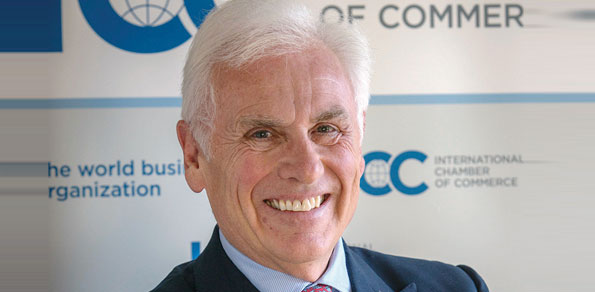
 The globalisation of business throws up as many challenges as opportunities, making it crucial that professionals keep abreast of changes in cash management and trade finance practice and innovation. International Chamber of Commerce (ICC) Secretary General, John Danilovich, explains why standardised, online professional education – that can be accessed by anyone, anywhere, at any time – could be the solution
Professional education is a vital component of business growth in the Middle East, yet it must be better aligned with changing global dynamics and business needs if it is to be a success.
As such, the timely rise of innovative and convenient education initiatives – such as the ICC Academy – can ensure professionals are up for the challenges posed by globalisation, as well as new practices and innovation in the cash management and trade finance industries.
A new world of opportunity
Increasingly, the Middle East is becoming a hub for international and interregional trade, as well as a gateway to key markets such as Asia, Africa and Europe – meaning it is ideally positioned to tap into shifting trade flows and profit from today’s truly globalised commercial environment.
Indeed, the ICC Banking Commission’s 2015 Global Survey on Trade Finance reveals that 7% of surveyed banks have their main trade finance centre operating in the region. Of course, this is not only due to the geography, but also the many advantages provided to the thousands of companies established in the various free trade zones across the Middle East – attractive tax incentives, competitive import/export duties and financing costs, high levels of liquidity, for instance.
What’s more, SWIFT data from the Global Survey on Trade Finance highlights that while trade finance messaging traffic decreased overall by 1.79%, the Middle East was the single region to register an increase (1.59%) in 2014.
This comes hand in hand with local authorities’ strong commitment to provide the structures and solutions needed to boost trade, such as increasing the availability of structured finance, promoting greater understanding of the merits of trade credit insurance, and developing technology platforms and processes in line with automation targets, as they look to further encourage movement away from a paper-based market.
Not only do such developments bring new opportunities for local banks and corporates alike, but new technology – with all the speed and convenience it offers – makes it easier than ever to contact and communicate with far-flung counterparties. Combined with the rise of trade, this is making business opportunities more abundant and accessible than ever before.
However, new opportunities are also often accompanied by challenges and complexities around unfamiliar currencies, counterparties and regulatory jurisdictions. In order for Middle Eastern banks and corporates to profit from the opportunities present across the region, employees need to be better informed of the different practices between counterparties, and stay abreast of changes across the industry.
Revolutionary e-learning platforms
Standardised, reputable, professional education – that can be accessed by anyone, anywhere, at any time – could be the solution.
New education initiatives are emerging through the implementation of dynamic and innovative e-learning platforms, with the goal of providing high-quality global education. The ICC Academy, for instance – ICC’s global education initiative – aims to encourage individuals across the globe to reach their highest potential with respect to professional competency and ethical conduct – allowing global partnerships to flourish.
Indeed, delivering education through digital platforms removes geographical barriers. This opens doors and broadens horizons even in the most challenging environments, as the only requirement for access is an internet connection. In fact, such platforms are helping to level the playing field between emerging and developed countries by providing ambitious students with opportunities for development regardless of their location.
Furthermore, digital platforms also have the capacity to remove time constraints. Rather than having to be in a specific place at a specific time, users now have the freedom to work around their own personal schedules. This is particularly beneficial to professionals, as not many have the desire or resources to take time off.
This digital levelling of the field also enables quality standardisation and raising of the bar in terms of achievement. The ICC Academy, for instance, develops its courses in one central location, which means the same high-quality education can be digitally disbursed around the world, creating a new global standard of education and supporting business practice compatibility.
Relevant and applicable education
Of course, the delivery of education via digital means is hardly a new initiative. E-learning platforms are already taking off in the Middle East, where we are seeing significant education growth. As the top performer, Oman has the highest market annual growth rate in the region at 19.6%, followed by Lebanon (16%), Turkey (12.9%), Kuwait (12.6%) and Qatar (11.3%), according to the 2014 Docebo report. What is crucial, however, is that the education available online, and to all, is sophisticated, and remains relevant and applicable – particularly if it is to prepare professionals for the complexities of the business arena in today’s fast-changing climate.
One way of achieving this is to recognise the different practical skills and academic degrees required for different functions. Through the ICC Academy we manage this by leveraging a roster of experts. The ICC Academy provides a channel whereby we can take the experts’ knowledge and expertise, digest it in a way that everyone can understand, and share it.
Indeed, the ICC Academy’s initial trade finance offering is centred around two major certifications: the Global Trade Certificate (GTC), which is ideal for general managers, sales managers, relationship managers, procurement and legal staff, and the Certified Trade Finance Professional (CTFP) course, which targets specialists working in banks or corporates in functions such as relationship management, credit, and compliance.
Equally important is access to a roster of subject-matter experts and extensive business and banking networks, allowing users to connect with and learn from experts and peers through attendance of workshops, seminars and conferences. Such initiatives ensure users stay up-to-date with the latest trends and developments, and facilitate an environment where all-important business relationships can flourish.
Staying a step ahead
Of course, it is not enough to train professionals for the challenges ahead, only for the landscape, opportunities and methods they were prepared for to be superseded – particularly given the volatile nature of the current global economic landscape. Instead, education must be a career-long pursuit, ensuring professionals stay abreast of changes within the industry – another reason why the convenience of education, and its ability to adapt around daily lives, is imperative.
Middle Eastern professionals have a stimulating path ahead of them, lined with challenges but also endless opportunities. By leveraging convenient, specialised and ongoing education initiatives, they will not only keep pace with changes, but stay ahead of the curve.