

Dear Reader,
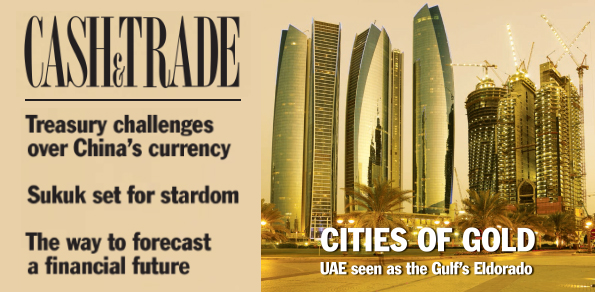
Mythology has it that Midas was a king who turned everything he touched into gold – a “talent” that the UAE seems to possess at the moment.
As we say in this issue, in an extract from the CMM’s 2014 UAE Tajara Monitor, “Black gold is not the only oil of industry in the emerging Emirati economies…In 2013, the increasingly important systemic role of the UAE financial sector in wider trade liquidity across the MENA region and Pan-Arab world as a whole was again clearly evidenced in many ways.”
It goes on to add, ”Moreover, the Emirates are collectively moving towards new economic models. The same level of vision that engendered world-class tourism and leisure facilities is now spurring new unfolding industries in a, to some, surprisingly broad spectrum.
“Amongst this second wave of modernisation is a wave of tangible goods based import, export flows and re-export flows and value-added manufacturing activities. Around these flows are secondary supporting hi-tech and media strands of development evidenced in the free trade zones, trade flows and increased value of banks intermediation through trade finance.”
Also, looking exclusively at Muslim finance, we report that the Sukuk is heading for stardom. According to several bankers in the Islamic capital market space, Sukuk activity by international issuers indicates that Islamic finance as a whole – and, especially the Sukuk – is becoming a more mainstream source of funding.
In an in-depth, up-to-date analysis of the situation, our correspondent estimates that if the growth trajectory of global Sukuk issuance continues as it has done over the past three years, it could become the iconic Islamic fund raising instrument, continuing to attract not only traditional issuers, but also non-traditional ones from a number of developed and emerging economies, including the UK, Hong Kong, South Africa and Luxembourg.
Concerning world trade as a whole, this edition finds that the cost of trade finance and the pricing of risk has stabilised or even fallen. However, new research has discovered that the need for some form of security is still widely felt.
The International Chamber of Commerce (ICC) 2014 Global Survey of Trade Finance (Rethinking Trade and Finance), has found that while business activity is now edging up, traders and banks do not yet feel this is a moment to let their guard drop.
For imports, the slow but steady decline in use of commercial letters of credit continued – sinking to just 36 per cent of transactions, from 39 per cent last year and 44 per cent in 2012. But this was offset by a four-point rise in the use of import guarantees (20 per cent of transactions) and a small pick up in the use of standby letters of credit.
The survey also concluded that the world trade recovery “is not yet vigorous and this, therefore, remains a buyer’s market”. So exporters find themselves under pressure to sell on open-account terms, which are cheaper and simpler; moreover, the growing use of electronic communication means that traditional letters of credit, which are still largely paper-based, are seen as inefficient, particularly where there is an established trading relationship between exporters and their customers.
Continuing with a global perspective, another article in this issue points out that the world of global payments is undergoing fundamental change, reshaped by technology and redefined by regulation, the emergence of new economic powers, and changes in the currency landscape.
It says that, effectively, what is happening is “a fundamental transformation with long-term implications. Indeed, in 2020, it will look very unlike it does today. Projecting further forward still, the payments market ‘end-state’ is likely to be a landscape rich with capability and added value, featuring user-friendly technologies with wide-spread adoption”.
It adds, “It’s therefore time for banks in the MENA region to gear up if they wish to be part of the payments market of the future.”
All in all, it is clear that as the year ends the Middle East and the world in general are facing changes on a number of fronts, and, naturally, Cash&Trade will be reporting on them for our readers as they occur.