
Dear Reader,
Millions of potential customers await those banks prepared to put the effort into developing economies. The realisation that there are huge swathes of what are termed “the unbanked” has woken up banking operations in rapidly developing countries and they are now showing renewed interest in reaching out to those potential new account holders as the technological pace of change in such markets is beginning to accelerate rapidly.
“Over the coming decade the dynamics of payments markets in rapidly developing economies will shift dramatically toward the financial inclusion of the unbanked, the replacement of cash and cheques and the reduction of cash-based, underground economic activity”, according to the Boston Consulting Group, quoted in this issue.
“At the same time,” it adds, “innovation in mobile payments, prepaid cards, and new payment technologies will provide great opportunities for the most nimble players, as well as pave the way for new market entrants.”
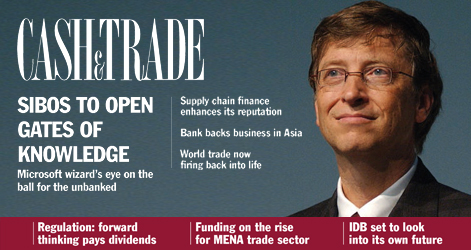
Coincidentally which we also report on in this edition, Microsoft co-founder Bill Gates’ closing speech at this year’s Sibos conference will focus on how to provide financial services to the least well off sections of society. Many conventional banks have believed that it is simply too difficult to do, but Gates expresses the view that “digital technology and partnerships can be used to facilitate delivery on a sustainable basis to those who are often beyond the reach of traditional banking”.
Unsurprisingly, compliance once again finds itself on the agenda in this issue. Banks cite regulatory compliance as one of their top priorities, and most focus on current regulations such as Basel III. However, trends are showing change as regulators start to shift their focus forward.
Currently, it’s seen that while regulations can increase banks’ resilience, they have largely concentrated on reporting or stress-testing using snapshots of present or past data. To ensure that banks are better prepared for the future a major shift is occurring, says the director of a leading financial analysis company, “as regulators start to use forward-looking indicators of capital utilisation that focus at least nine financial quarters ahead”.
He adds, “To implement these forward-looking indicators, regulators are considering new stress tests, translating their impact to income statements and the balance sheet, and telling banks what needs to happen. This means less disparity between banks and encouraging changes that bring finance and risk management closer together.“
Turning to another topical subject, we look at supply chain services, the growth rate for which averaged between 30 and 40 per cent for global banking institutions between 2011 and 2013, according to a survey by international consultants Demica.
It believes that in the atmosphere of tight corporate credit over the past few years, supply chain finance has become an increasingly attractive and important working capital management tool.
It says, “As the optimisation of cashflow now occupies a top position on the business agenda, corporates are examining their cash-to-cash cycle with greater attention and are exploring ways to extend their Days Payable Outstanding. This, however, should not come at the expense of supplier companies, particularly SMEs, which have been hit the hardest in terms of credit availability and price.”
We also bring to readers’ attention the fact that export credit agencies (ECAs) are stepping up their strong support for MENA projects as well as supplying additional classic trade financing products to the region.
The conditions that have led to the increase in use of ECA funding have largely continued unabated. Foremost, as the cost of projects has increased in a push for economies of scale by sponsors, more sources of help must be tapped.
The high cost of materials and services has also led to big price tags on engineering, procurement and construction contracts, so project sponsors and their advisers have looked to raise money from as many pools as possible. This has often encouraged them to tailor their contracting and procurement, where possible, to countries where ECA funding can be secured.