

Dear Reader,
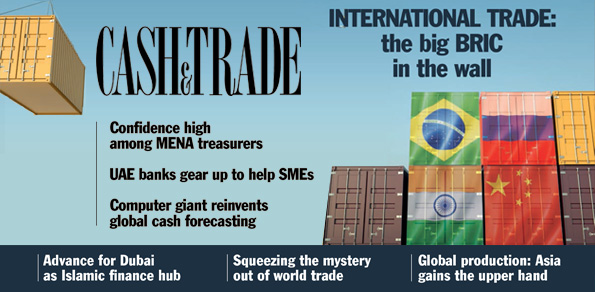
What this issue makes clear is that trade and its financing are to grow in the BRIC countries: Brazil, Russia, India and China.
As a whole, emerging markets are increasingly coming to the fore but it is the BRIC economies that are getting up the biggest head of steam. Indeed, it is expected that by 2018 they will represent more than 30 per cent of total global output – making them larger trading partners than either the US or Europe.
Buoyed by this growth, the world’s economy is finally showing signs of improvement – prompting corporates to turn their attentions to multinational expansion as they see that emerging markets are likely to offer the most rewarding potential.
Coincidentally, the balance of global production has swung back in favour of Asia as a whole. By 2020, it is expected to account for 35 per cent of world trade and will continue to be the driver of growth for the foreseeable future.
In fact, its economic ascension is already re-ordering the ranks of the world’s top-10 trading centres. In 2001, Japan and China were the only Asian nations in that group. By 2020, it’s said that six Asian nations will be in the list. China will jump to the number-one position, bumping Japan into second place. The four others will be India, South Korea, Singapore and Hong Kong.
As trade itself evolves rapidly, banks across MENA face major technical and management challenges if they are to remain a force in the fast-changing environment of today’s transaction banking – particularly if they want to hang on to their biggest clients.
In this issue, we reveal that research by the financial software group Misys has uncovered the fact that major international banks now recognise the need for a massive step change in the way that they deliver transaction services.
Faced with rising expectations from business customers, particularly those engaged in foreign trade, the world’s big banks have concluded that they must invest heavily in new systems to integrate services that they still deliver as separate products.
Also in this edition, an international trade author and regular Cash&Trade contributor looks at why the “veil of complexity” should be lifted on global trade and investment.
He takes the view that “the financing of international trade involves a particular discipline and a set of long-established products, practices and solutions that are, for their proven effectiveness and demonstrable longevity, rather poorly understood outside of a small cadre of global specialists and practitioners”.
He believes that even some senior trade financiers will admit that this is largely the result of a “veil of mystery and complexity” that has evolved over time, and that practitioners have allowed to remain, “as it served the preference of senior experts for doing business in the background, maintaining the confidentiality of clients, and keeping the business of trade finance as something of a club with a rather exclusive global membership, particularly at its most senior levels”.
This edition also looks at how Dubai is ramping up its bid to be the hub of Islamic finance with the aim of becoming the “global capital” of the Islamic economy. In particular, we report on four new initiatives launched in recent weeks that are aimed at sustaining the momentum of that aspiration.
As it happens, the UAE is also taking the initiative in helping SMEs. A paper published last year identified what were termed the “missing middle”, those MENA companies past initial start up with revenues of between $100,000 and $5m and between six to 150 employees. The study claimed they were “underserved – with loan denial rates particularly high in Jordan and Saudi Arabia” – and added that they needed “an enabling business environment to address barriers to their development”.
Now, as we report in this issue, banks are hearing the call and are increasingly tailoring programmes to foster development of SMEs.