

Dear Reader,
When it comes to new IT, finance directors have to face two questions that are inextricably linked. They are, “Can I afford to invest in the right technology; and, on the other hand, can I afford not to?”
Our Cover story poses another question: is it possible for corporates to remain competitive without regularly refreshing their IT to keep up with the latest systems that their competitors may already be planning to buy or, indeed, are already using?
This is particularly the case for treasury tasks such as cash management and foreign exchange, where the sheer volume of work to be handled imposes pressure and the risk of mistakes.
It is dilemmas such as these that are persuading many companies to consider entrusting treasury operations to “the cloud” – servers hosted on the internet.
Cloud computing – the use of those remote servers to store, manage, and process data – is now increasingly widespread in many areas of business life. Our article looks at its advantages together with a number of implications, especially data security.
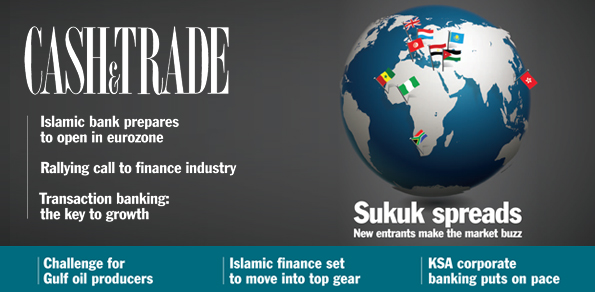
If 2013 was a year of consolidation following the record year of 2012 especially for Sukuk origination and syndicated Murabaha loans, then 2014 promises to be a potential game changer in several key respects for global Islamic finance.
In a review in this edition, we look at how the industry hopes to move into top gear and, “judging by developments in the last quarter of 2013, the key trends and momentum that are emerging for the New Year pertain to five key areas: the Sukuk market; cross-border regulation; Syndicated Murabaha; Commodity Murabaha (Tawarruq); and mainstreaming Islamic finance”.
In another article, we look at an advance on the Islamic banking front, reporting on a MENA consortium that is preparing to start up an operation in the eurozone. It will be headquartered in Luxembourg and have branches in Germany, France, Belgium and The Netherlands.
The consortium comprising a reputable bank, royal families, and a group of leading businessmen in the GCC, announced its intentions at the Global Islamic Economy Summit 2013 held in Dubai last November. Luxembourg has been chosen because of its robust macro-economic environment and supportive regulatory framework for (Islamic) financial services.
According to our own Tajara Monitor, in Q3 2013 the corporate banking and trade finance segment in the KSA continued its strong performance against the key measures, with total trade-related contingent liabilities setting record levels.
Riyad Bank retained its lead in the overall CMM Corporate Banking and Trade Finance League Table but lost its number one position in the trade-related contingent liability table to SABB, whose total of SAR 78bn continued its strong upward momentum.
Gulf producers’ reliance on a high oil price has increased over the past few years as government expenditure has surged in response to social pressures further heightened by the Arab Spring unrest. Now, though, there is the possibility that the US will become the world’s largest oil producer by 2015 due to fracking.
However, as we report in this issue, OPEC is confident that it can “ride out this storm”. It said that while the “call” on (demand for) its crude will fall year on year until 2017 to 28.8m barrels per day (b/d) versus current levels of 30.3m b/d, it expects to see a marked uptick by 2020 as shale oil production reaches a plateau.
OECD energy watchdog the International Energy Agency agrees, suggesting that while non-OPEC supply will play a major role in meeting oil demand growth this decade, OPEC will play “a far greater role after 2020”.
But it’s noted that Gulf producers are also faced with a rebound in production from Iran, which in November reached a six-month interim agreement with Western powers to restrict its nuclear industry in return for relaxing sanctions. Tehran is now seeking to return production from the current 2.4-2.7mn b/d (opinion is divided on exact figures) to pre-EU sanctions levels of 3.5-3.7mn b/d and, ultimately, wants to raise it to just above 4mn b/d. However, sanctions will not be lifted immediately, and it’s said that it will take some time to secure the equipment needed to implement the planned increases.