

Dear Reader,
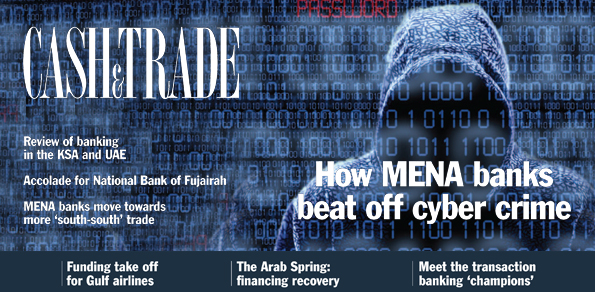
As we all know, online security comes with a challenge: beating back the bandits. Without doubt, systems are becoming more sophisticated but, unfortunately, so are those dedicated to cyber crime.
With this in mind, many MENA banks now have to spend heavily on cutting-edge technology to keep their clients’ finances secure and protected from fraudsters. In this issue, we look at what’s going on behind the scenes.
Few industries can have felt the positive impact of automation and online technology to such an extent as banking. What seemed implausible not so long ago is now routine, with massive benefits for efficiency, cost-saving, speed and the simplification of procedures that only a decade ago were generally laborious and bureaucratic.
But for all the advantages that it brings, the advent of electronic online financial services has opened up new avenues for theft, particularly where transaction functions such as cash management, trade finance and bulk payments are concerned. This has led to the devising of hugely complex and rigorous procedures to combat criminals.
The fact that Dubai is edging forward in its bid to become the next offshore renminbi trading centre is just one sign of the fact that increasing numbers of Middle Eastern banks are gearing up for more “south-south” trade.
One of our other articles takes a “banker’s eye” view of evolving trade patterns on the region’s transaction banking provision and the role local-global bank collaboration can play in navigating the shift from intra-regional to international trade – and chiefly that conducted with developing markets.
The feeling is that “south-south” trade is now one of the main drivers of the global economy. Indeed, according to the World Bank’s June 2013 Global Economic Prospects, more than half of developing country exports now go to other developing economies – and this trend shows no sign of abating.
Such a shift in trade focus from west to east is a key development for the Middle East, as its position between the growth markets of Central and Eastern Europe, Africa and Asia makes it a gateway for intra-emerging market trade.
Whilst on the subject of transaction banking, current market dynamics are pointing increasingly to wholesale transaction banking as a “key lever” for improving return on equity in the global banking industry.
In 2012, according to another correspondent in this issue, wholesale transaction-banking revenues were about $220bn, or roughly 15 per cent of the total corporate-banking revenue pool. Nearly $140bn was from transaction-specific fees and current-account-related revenues and a further $80bn was from value-added services, such as information reporting and trade-related actions.
He says, “Transaction fees and account revenues combined are projected to grow at a CAGR of 10 per cent through 2022, reaching more than $350bn. This expansion will be driven by modest but steady growth in the developed economies, continued strong growth in rapidly developing economies and margin improvements as the yield curve rises and steepens…”
Further evidence of MENA extending its global reach is the fact that the region has seen a massive surge in aviation industry growth. At the start of the 1990s, it operated 218 aircraft with 100-plus seats but by the beginning of this year, 875 had taken to the skies.
Record orders for new aircraft have been placed by regional airlines in the MENA region, and the main driver of such growth, which Airbus called “second to none” in its Global Market Forecast released in September, has been the push by Gulf countries to serve as hubs connecting not just the region, but major cities across the world.
More than half of the Middle East’s aircraft are operated on medium-and-long-haul routes “highlighting the global strategy adopted by the region’s airlines”, commented the aircraft manufacturer.
Inside, we look at what made it all take-off and how it’s funded. We also look at the potential cost of funding the Arab Spring countries, which are said to need billions of dollars to see them through “transition”.
The countries in question – Egypt, Jordan, Libya, Morocco, Tunisia and Yemen, all with huge structural economic and financial problems – maintain that they need billions of dollars in assistance to help them through a crucial period towards a more democratic and accountable political and economic dispensation.