

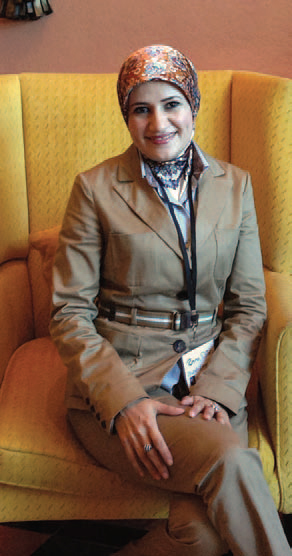
A range of senior positions in banking and treasury in the MENA region are now held by women. PAUL MELLY speaks to some of them
Determination, self-confidence and a willingness to defy stereotypes – these are the sort of qualities that take women to the top in finance in the Middle East today.
But ability alone is not always enough. In a world where men still occupy most senior posts, female contenders for career success in banking or the treasury and accounting teams at major businesses must demonstrate exceptional talent and willpower to break through.
Not that the rest of the world has much to boast about when it comes to financial sector job opportunities and promotion for women. Women are under-represented in senior financial posts almost everywhere.
But in seeking to tackle this issue, and open up career paths for their female citizens, Middle Eastern countries face particular challenges because of of the influence of traditional social norms.
There can be practical complications too, particularly in Saudi Arabia, where there are still widespread constraints on the extent to which men and women can share the same workspace
However, today a number of women have shown that it is possible to pursue a successful career in finance – and reach top management roles.
“The participation of the women in senior financial positions in the region is small, but it is rising…women are best represented in finance,” says Reema Diab, finance manager at Alcatel-Lucent in Amman.
Put she points out that across the region women now work in a range of senior financial positions, such as chief accountant, finance manager, financial controller and CFO (chief financial officer).
Prominent names
Among the women with the highest profile are Lubna Olayan and Nahed Taher. The former, now chief executive of the Olayan Financing Company, based in Riyadh, has been a vocal and early advocate of equal opportunity for women.
Meanwhile, Taher worked as an economist at National Commercial Bank (NCB) in Saudi Arabia, before setting up her own institution, Bahrain-based Gulf One Investment Bank. During Taher’s stint at NCB the bank recruited dozens more women. And now, running her own operation, she has herself hired many more.
Other pioneers of female success in the Middle East’s financial sector include Assila Zaher Al-Harthy, chief executive of the Omani private equity firm Group 6, and Sahar Mohammed Ali El Sallab, who became managing director of Commercial International Bank (CIB), the largest private sector bank in Egypt.
Soha Nashaat, half Egyptian-half Syrian and brought up in Kuwait, pursued an international career with Merrill Lynch before returning to the Middle East, where she became managing director of Barclays Private Bank in Dubai.
In Bahrain Sheikha Hessa Bint Khalifa Al-Khalifa is chairwoman of Al Salam Bank, while Sabah Khalil Al Moayyed rose to become chief executive of Eskan Bank.
Kuwait: a pioneer
However, it is probably Kuwait that offers the standout example of female success in financial sector careers.
Riham Fouad al-Ghanim is vice-chairwoman of Kuwait Finance and Investment Company – where she is one of three female directors on the seven-member board. She is also a senior figure in the Alghanim family business group.
Maha Al Ghunaim is the founder of Global Investment House, one of the Gulf’s largest investment private sector companies. Established in 1998, the firm became the first Kuwaiti business to list on the London Stock Exchange in 2008.
Global Investment House was hit hard by the financial crisis. However, banks across the region have supported a complex debt restructuring to place the firm back on a solid and debt-free footing.
This process, finally completed in late July 2013, has separated the core fee-earning investment management business from the old debt and assets. The widespread support for the restructuring is a reflection of Maha Al Ghunaim’s success in having created an investment firm that really has been of strategic importance for the development of the financial sector in the Gulf as a whole.
In many cases, successful women financiers have been those who established their own businesses, who have been able to draw on family wealth to set up institutions or who have headed up offshoots of existing family business empires.
But this not always the case. Sheikha Al Bahar is chief executive of the Kuwait operations at the National Bank of Kuwait group, one of the Gulf’s largest banks. She joined this powerful institution as a trainee.
But today she is in charge of lending, marketing, investment banking, treasury and large individual or structured transactions. She also oversees the group’s Egyptian offshoot.
The prominent role played by women in Kuwait’s financial sector is to some extent a natural product of the country’s early role in opening up educational and employment opportunities for women, including recently, as elected parliamentarians. They had already reached senior posts in sectors as diverse as the media, oil, academia and government, often well before female counterparts elsewhere in the region.
Remaining challenges
But across the Gulf there is still a good way to go. Sheikha Hessa Bint Khalifa Al-Khalifa recently highlighted the need for a change of culture in many organisations, pointing out that women mostly hold only junior or middle management roles. In banking, she argued, they are still “dismally represented”.
And, in part, the challenges that women have faced in pursuing financial careers are only a wider reflection of the difficulties they have still to overcome in the wider Middle Eastern business world.
The International Finance Corporation (IFC), the private sector finance arm of the World Bank, seeks to foster the growth of small firms in 25 countries around the globe by channelling finance to them through 34 local banks. IFC says that of the SMEs that it supports in this way some 16.4 per cent worldwide are majority owned by women.
But in the Middle East and North Africa, the proportion of these SMEs that are female-owned is a mere 5.7 per cent – far lower than in any other world region. This compares, for example, with 15.1 per cent in Sub-Saharan Africa and 26.6 per cent in East Asia and the Pacific.
However, there are powerful factors that could well drive future change, opening up fresh opportunities for women to occupy senior positions in banking and in the financial management of major companies in the Arab World.
Both education and demographics are exerting pressure in this direction.
Women do consistently well in higher education across the Gulf, commonly accounting for a large majority of students at university. So they represent a massive pool of potential well-qualified recruits.
Meanwhile, Gulf governments are constantly seeking to reduce their countries’ reliance on expatriate workers, particularly for skilled non-manual jobs. With economies in the region growing strongly, the challenge is to find sufficient local staff from the national population.
A failure to recruit sufficient numbers from the female half of the indigenous workforce could be seen as wasting the potential ability of young Gulf citizens and simply perpetuating the shortage of qualified local personnel to fill financial sector positions.
The recruitment of more female personnel also makes sense from a customer service point of view. Women are a large and often affluent segment of the Gulf banking and personal investment market. n
A woman’s view of regional prospects
Cash & Trade asked Reema Diab, finance manager at Alcatel-Lucent, for her assessment of the business climate.
Q) How do you view the current economic outlook for the Gulf region ?
A) From my point of view, I see good news for the Gulf’s positioning, relative to other parts of the world. But companies are still cautious about the impact of regional and global events on local economic activity.
Broadly, economic activity across the Gulf region has been solid in most areas. But the social, political and economic transformation under way in some parts of the broader MENA region means that business leaders are still exercising caution.
Q) What are the principal challenges facing banks?
A) The biggest challenge facing banks today is the economic crisis facing many countries in the world. There is also the public mistrust of the banking system which is affecting the banks negatively.
1 Comment
Women are on the rise in finance http://t.co/LOpq8YbCt9