
Dear Reader,

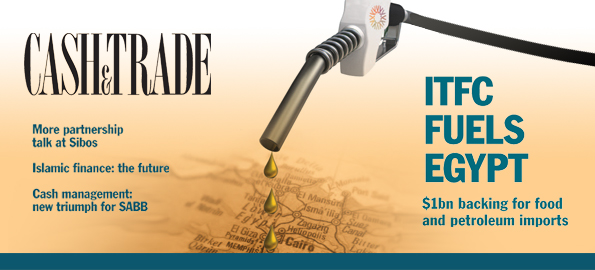
Egypt has recently benefited from $1bn worth of backing from the International Islamic Trade Finance Corporation (ITFC) in what many might consider an unprecedented act of good faith. Only two days after Mohamed Morsi, Egypt’s first democratically elected president, had taken office, ITFC signed an agreement with the government to finance petroleum and food imports over three years.
As the author of a report about this act of “bridge building” says in this issue, “Times of fragile confidence are the real tests of friendship and as the inevitably uncertain process of political change moves forward countries such as Egypt need to know that they have allies they can count on.”
At a time of on-going crisis in the global economy, there are not many institutions such as ITFC with the assets and strength to take a long-term view of trading potential and debt service reliability in a region undergoing change on the scale experienced by North Africa.
Understandably, with a new governing team barely in place and many of the key constitutional decisions yet to be taken, private sector banks and investors have little choice but to be cautious in their approach to Egypt. However, a strong economic performance in recent years offers encouragement that the country will gradually be able to find its way back onto a path of solid growth and increasing competitiveness.
IFTC is an autonomous entity within the Islamic Development Bank (IDB) group. It was set up in 2008 to provide funding support for trade on sharia-compliant terms, and to promote “south-south” trade between countries belonging to the Organisation of Islamic Conference. Hitherto, the IDB used to provide trade finance through a range of different facilities and credit windows, but these activities are now grouped under one umbrella – ITFC.
High on the agenda at Sibos, the world’s premier financial services event, was the need for banks “to build next-generation, future-proof transaction banking models; introduce greater innovation into their offerings; and form strategic partnerships to drive forward their businesses in an ever-changing, global financial services environment”.
Partnerships between banks were a particularly big topic, and, as is set out in another article in this issue, “there is now a much greater focus on how banks can work together to acquire more business and help each other service clients in markets where they do not have a local presence”.
One leading MENA banker is quoted as saying,“Many Middle Eastern banks are now investing in sophisticated transaction banking products and services to meet the requirements of large local corporates. They are also reaching out to some international banks, and entering into greater dialogue and discussion with those banks about how they can help them service clients in those Middle Eastern markets where they (the international banks) do not have a local presence themselves.”
The Bank Payment Obligation (BPO) continues to build on the pace and substance evidenced by its market debut earlier this year, and in this edition we look at its progress
Having undergone extensive comparisons to letters of credit and many discussions about what it is not, the BPO now has its own affirmative definition. It is expected to sit comfortably alongside letters of credit, guarantees and collections as a new trade finance instrument for the 21st century with a unique set of attributes that can facilitate greater speed, certainty and discrepancy resolution in designated trade transactions.
Recent reports indicate that GCC countries – notably Saudi Arabia, Qatar, Bahrain and the UAE – are strongly positioned to meet the requirements of Basel III and are already making significant progress towards implementation. However, this should not be taken to mean that Basel III is without its challenges.
In this issue, a leading banker looks at the debate and particularly the potential effects of Basel III on both banks and international trade. Interestingly, discussions show no sign of slowing as January 2013 – the date by which banks worldwide must begin implementing Basel III rules – approaches.