

Corporate adoption of SWIFT has been a growing trend for many years, according to MARCUS HUGHES, director of business development, Bottomline Technologies
The focus on SWIFT for corporates has been sharpened due to its new electronic invoicing (e-invoicing) initiative. Whilst there is general agreement on the payments and cash management benefits of joining SWIFT, adoption by corporates has generally been slower than anticipated.
Now SWIFT and its partners are hoping that by supporting the industry shift towards e-invoicing, adoption rates will increase as the value proposition for corporates becomes increasingly compelling.
Although electronic payments have become more prevalent in recent years, many organisations, especially in North America, have not yet made the complete transition. There are several factors that contribute to this:
- perceived cost of migration from paper to electronic payments
- lack of trust amongst buyers and suppliers to handle each other’s bank account information
- inability to handle rich remittance data via electronic payments
- lack of internal resources for taking on an e-payments project.
Automating the full order-to-pay function enables a corporate treasury to have early visibility into cash flowing in and out of the organisation as well as better control over payment timing, early payment discounts and investment opportunities. By combining this process with SWIFT’s solutions for payments and cash management, companies can squeeze every penny out of their financial supply chain.
E-invoicing is a logical next step after achieving payment automation and a further reason for adopting e-payments in the first place. E-invoicing today is handled through a large number of unconnected networks spread around the world. SWIFT is, therefore, taking on the valuable role of creating secure and reliable inter-operability between providers and delivering common standards.
With a handful of pioneering banks and technology partners, SWIFT is developing a new value-added service for its banking and corporate community by making it easier to connect different e-invoicing networks.
In this way, it can extend the reach of service providers, which, with only a few exceptions, are generally focused on domestic e-invoicing. If SWIFT is successful, this will be an important first step in helping reduce the barriers to a more widely adopted and accepted world of e-invoicing.
New four-corner model
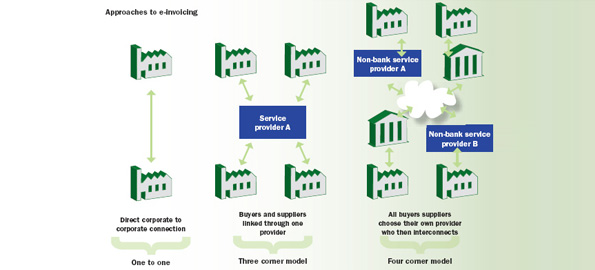
Today, most e-invoicing networks are based on a so-called “three-corner model”: the buyer and supplier have separate contracts with the same service provider and interact through a central hub. These service providers can be banks or technology solution providers.
However, in a “four-corner model”, a corporate can interact with a corporate or bank in another network. Each corporate’s service provider manages the connectivity (through SWIFT) with the other corporate’s service provider.
This standardised and secure interoperability means that a corporate can exchange invoices with counterparties anywhere in the world by linking together the buyer and supplier’s separate networks, as can be seen in the chart below:

SWIFT service bureaux belonging to experienced technology providers are particularly well placed to offer this valuable connectivity, given their expertise and their own e-invoicing customers and networks. Similarly, banks already offering e-invoicing solutions or looking to partner with e-invoicing technology providers are also positioned to drive this market opportunity. Therefore, the “four-corner model” looks set to gain traction, thanks to collaboration between banks and e-invoicing service providers.
Best of both worlds
The combination of a large, feature rich payment and invoicing network which is enabled to access SWIFT e-invoicing brings together the best of the “three-corner model” and the “four-corner model”. A platform that spans the entire order-to-pay cycle offers many benefits in terms of better visibility and control, lower costs, improved working capital and enhanced buyer and supplier relationships.
Furthermore, the extended reach offered by SWIFT e-invoicing means that a business can exchange e-invoices with customers and suppliers internationally, even though they are not part of the same network. This arrangement does not afford the same level of visibility over the invoice status or allow flexible dispute management workflow as users on the same payment and invoicing network enjoy. But users will have confidence that comes with safe receipt and non- repudiation, as well as common standards.
Advantages for banks
A growing number of banks are recognising that e-invoicing makes a logical and attractive extension of their transaction banking services. It provides a low risk revenue opportunity to generate credit balances and fee income while deepening customer relationships and creating finance opportunities.
Banks are continually concerned about being disintermediated from cross-border trade flows and understandably so. Over the past 20 years, there has been a growing trend for traditional trade finance instruments, such as letters of credit, to be progressively replaced by open account trade terms. There are a number of exceptions to this trend, such as commodity traders, structured trade finance and new business relationships with counterparties in some of the more challenging geographies.
Rather than being involved from the start of a transaction with the issuance of the letter of credit and playing a valuable role throughout the transaction life cycle, in open account trade, banks have visibility of the transaction only when the corporate sends them a payment instruction. In many cases, this is too late for the bank to offer its risk mitigation and finance products that would provide additional benefits to its corporate customers and their supply chain.
By offering e-invoicing as a service to customers doing business internationally, banks can regain early visibility and, indeed, earlier notice of trade transactions. Banks can then take a stronger position to provide financing solutions, with an opportunity to mitigate risk, thanks to technology.
Solution that mitigates risk
Exporters and importers are constantly looking for new ways to mitigate risk, gain easier access to finance and support cross-border trade. To optimise open account trade, SWIFT has developed the Trade Services Utility (TSU), an automated solution that mitigates risk by enabling banks to issue conditional payment guarantees in support of trade transactions.
These are conditional guarantees, known as Bank Payment Obligations (BPOs). They enable an importer’s bank to promise to pay a specific sum of money to an exporter’s bank at a specified future date, provided that the invoice(s) presented match with the purchase order or contract related to this transaction. The TSU enables the matching of this data in a highly automated and timely manner.
This scenario has many parallels with a letter of credit, which traditionally involves manual matching of paper documents by specialists in trade banks. But in the case of the BPO, communication is in the form of electronic messaging sent via SWIFT from which the data can be matched automatically. However, just like a letter of credit, a BPO can be used by banks to mitigate risk and provide a range of financing solutions to buyers and suppliers such as post shipment factoring, reverse factoring and pre-shipment finance.
A key advantage of a letter of credit is that they have an internationally recognised set of guidelines (The Uniform Customs and Practice – UCP 600) that are managed by the International Chamber of Commerce (ICC). This provides users around the world with the confidence of an established set of rules governing the usage of this traditional trade instrument. At present, SWIFT’s BPO does not yet have this vital international recognition and framework for interpreting guidelines.
However, SWIFT and the ICC are in discussions as to how the latter can take over responsibility for the Bank Payment Instrument. This would give the BPO the widespread recognition and credibility of an international trade instrument, which should act as a significant catalyst for driving adoption of the BPO in trade finance. In turn, corporates and banks will find it much easier to mitigate trade risks and arrange supply chain finance in an automated and efficient manner, for both pre-shipment and post shipment finance.
Potential for streamlining
 As the trend continues towards corporates automating more of their cash lifecycle, organisations that surround those transactions will need to find new ways to support them. SWIFT’s e-invoicing and BPO initiatives offer exciting potential for streamlining international trade processes and mitigating risk.
As banks and corporates gain confidence in this new proposition, the industry is likely to see growing traction over the coming years. These new initiatives are highly complementary to existing payment and invoicing exchanges, which will benefit from extended reach and standardised interoperability with other networks. Adoption for e-invoicing and for SWIFT will continue to benefit the bottom line of banks and their corporate customers.
The union of a large payment and invoicing community with SWIFT e-invoicing offers feature rich functionality for users on a common platform and extended reach to outside buyers and sellers, all interacting electronically.
The added value of the feature-rich platform at the heart of the payment and invoicing network creates a strong incentive to join the inner circle, enabling greater visibility and new efficiencies. The extended reach offered by SWIFT e-invoicing is a further reason for adopting e-invoicing for cross-border trade. n
Marcus Hughes serves as director of business development for Bottomline Technologies. He is an expert on transaction banking, and possesses more than 20 years of experience helping some of the world’s largest banks and financial institutions devise and implement strategic initiatives for international cash management, trade finance and financial supply chain.
Bottomline Technologies (NASDAQ: EPAY) provides collaborative payment, invoice and document automation solutions to corporations, financial institutions and banks around the world. The company’s solutions are used to streamline, automate and manage processes involving payments, invoicing, global cash management, supply chain finance and transactional documents.