
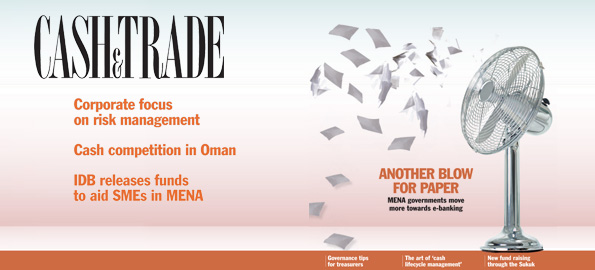

Dear Reader,
The importance of managing cash effectively and having visibility and control over it cannot be overstated. For example, in the current climate careful timing over payments and receipts can be hugely beneficial, while the ability to minimise counterparty risk by rapidly moving cash to more stable banking partners is invaluable, especially in the event that the eurozone crisis deepens
This is the tenor of one of our main articles, which points out that 2012 already looks as though it will be another highly challenging year for corporate treasurers, despite the fact that the scars left behind by the 2008 credit crunch – and resulting financial crisis – have barely faded.
Despite government promises that the banks will lend more, it is actually becoming more difficult for corporates to borrow. The tighter credit environment heightens financial risk and makes access to cash and the availability of working capital a critical factor for business survival.
Corporates are facing tougher lending criteria as banks become more stringent about whom they lend to, particularly as many foreign banks and niche lenders have retreated from the market.
However, the article contends that “effective management of cash throughout its entire lifecycle can help steer a steady course through the choppy waters of the current financial crisis, and may even open up new opportunities for the forward-thinking corporate treasurer”. It also suggests that corporates demonstrating sound cash management will find it easier to access credit.
It adds that the role that the SWIFT network can play “is critical to achieving a true cash lifecycle management vision. With this approach, corporates and other non-bank financial institutions will benefit from lower costs, greater efficiencies, enhanced decision-making and reduced operational and financial risk.”
Another trend towards greater efficiency is currently being practised by governments across the MENA region. Many are now seeking to secure greater funding from both banks and other external sources for a range of public sector projects, particularly infrastructure, while also ensuring that they manage their own internal liquidity more effectively.
Moreover, whereas in the past many ministries worked with autonomy, and had paper-based relationships with their banking partners, today there is now a big movement towards both centralisation and e-banking, says another article in this edition.
One senior regional banker is quoted as saying, “Government expectations were changing prior to the unrest but, since then, the social agenda has taken on much more importance in terms of the timeliness of its execution. This has led to objectives to centralise the activities of various government ministries, the increased adoption of shared service centres and the move to a more automated environment.”
He also pointed out that products being offered to citizens were becoming more sophisticated – and less cash-and-paper-based – as governments sought to maximise both efficiency and their own returns. Many government agencies are also running Enterprise Resource Planning (ERP) systems to track payments and receivables.
It notes, too, that transaction banking has recognised a greater movement towards automation, which is happening in three key areas: account reconciliation; the handling of government payments; and the streamlining of collections.
Having evoked “transaction banking”, it is interesting to read that it is now becoming a far more popular career choice. In fact, as a writer for an on-line careers publication claims in this issue, it is “quietly booming” at the expense of the former popularity of investment banking.
He says, “While the conversation around investment banking centres around whether the current headcount reductions are cyclical or the start of a fundamental shrinkage of the industry, banks are building out their transaction banking functions.”
1 Comment
Cash & Trade Magazine – May-June issue is out – Sign up ! http://t.co/ge223vcN #Saudi #Cash #UAE #trade #islamicfinance #SME
Cash & Trade Magazine – May-June issue is out – Sign up ! http://t.co/ge223vcN #Saudi #Cash #UAE #trade #islamicfinance #SME