
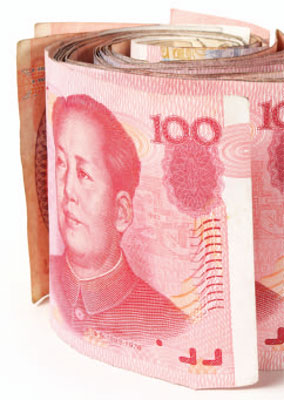
 China’s banknote will eventually become a major global reserve currency. This was the view expressed at Sibos. PAUL MELLY looks at what else was discussed at the world’s premier financial event.
The renminbi will eventually become a major global reserve currency, alongside the dollar and the euro. This was the consensus view of bankers and economists attending a Sibos seminar on the future of China’s currency – and the fact that almost no one disagreed is a striking illustration of how far the financial world is changing.
The debate also highlighted the sheer breadth of this tentacular annual get-together for the financial industry. Session topics ranged from the most general headline economic and market issues to highly specific technical developments, with a dose of futuristic star-gazing thrown in for good measure.
This year’s venue was Toronto, Canada’s banking capital, with Osaka to follow in 2012. But, after that, the world’s bankers and financial technicians will be going to the Gulf, when the 2013 edition of Sibos is hosted by Dubai.
For such a crossroads region, where trading flows and business trends from so many other economies coincide, major international trends in banking and its support technologies are particularly important. Gulf banks simply cannot afford to think in terms of purely local demand in their development of services and supporting technical structures; they inhabit an area where the home market is of limited size and business is largely internationalised; and exposure to outside influences is the norm.
The future status of the Chinese currency is an issue that Middle Eastern bankers, governments and sovereign wealth funds cannot afford to ignore – just as, with an affluent and well-travelled domestic public, they must stay abreast of the latest developments in electronic banking. The implications for trade finance of the new Basel III international banking standards will really matter in trading cities such as Jeddah, Dubai and Manama.
So Sibos is a useful opportunity to take the global temperature, particularly at such a testing time for the world economy and for the banking community.
The future of the renminbi is a particularly interesting issue for an oil-producing region such as MENA, where both national governments and individual big financial institutions will have the opportunity to build up substantial hard currency reserves. Another major oil exporter now piling up reserves, Nigeria, has just announced plans to invest between five and 10 per cent of those in the renminbi.
The internationalisation of the renminbi has already begun, Kenneth Ge, vice-chairman of Bank of China’s UK offshoot, told Sibos. Libo Wang, a deputy general manager at ICBC, forecast that this process would be a three-phase one, beginning with the Chinese currency used for trade payments, before it moves on to attract investors, with an eventual graduation to dollar/euro style reserve status following after that.
This will matter to commercial banks in the Gulf, whose economies are major exporters of oil or gas to east Asia but also import heavily from China in particular.
As for how long this will take, views were divided. HSBC has publicly suggested a 10-year timetable, but the bank’s head of payments and cash management for Asia-Pacific, John Laurens, hinted that the breakthrough to full convertibility could come earlier than expected. “With China, surprises tend to be on the upside,” he said.
Basel tightens belts
Not all thought-provokers facing Middle Eastern banks are so positive, of course.
As supervision authorities battle to contain the fall-out from successive international financial crises, the Basel regime of prudential bank regulation is being toughened up. There are countries that have yet to fully adopt the current Basel II rules, but already a third and tougher version – Basel III – is in preparation.
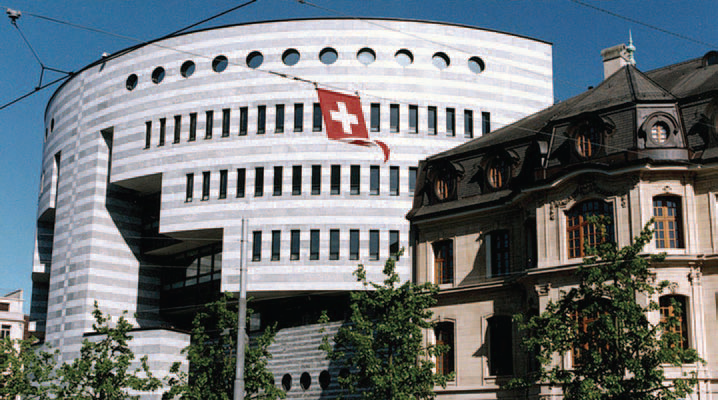
But there is concern among many banks that the new regime could prove to be an unnecessarily harsh constraint on the funding of international trade – and that could have serious implications for many banks in the strongly trade-oriented Gulf economies.
The worry is that rules designed to force banks to set aside large amounts of capital against the risk of default on their mainstream lending, will severely limit their ability to engage in trade finance.
The latter is, in fact, a rather low-risk activity, because the lending is directly linked to goods that are being shipped and have a physical value; moreover, trade finance is underpinned by tools such as letters of credit, credit insurance and so on. Indeed, trade finance is often one of the first services that banks feel able to provide in countries that have major political or economic problems because it is a relatively low-risk type of lending.
Sibos saw bankers express concern that the rate of obligatory “credit conversion” currently planned by the committee drafting Basel III would impose extra capital costs quite out of proportion to the level of risk that trade financing entails.
Kah Chye Tan, head of global trade finance and working capital at Barclays Corporate, said the new rules could force a big bank with $50bn in trade finance on its books to set aside some $5bn. Adnan Ghani, global head of trade finance at RBS, said the banking industry needed to get clients who benefit from trade finance, such as small-and-medium-businesses, to join the lobbying of the Basel Committee.
In fairness, it does look as though the committee is willing to listen. But Tan called on banks to talk to their national trade ministers to reinforce their message.
Yet he also believes that banks have to accept some of the blame for the present problems.
“Basel-bashing is the popular thing to do nowadays, but as an industry we should reflect on ourselves,” he said. “We’ve had 20 years to get our act together and we haven’t. Why did we have to wait for a major sub-prime crisis before getting our act together? We can’t keep putting the blame on Basel.”
Islamic opportunities
One theme to emerge clearly from discussions at Sibos was the huge potential for further growth in Islamic finance, particularly given the investment capital available in Middle Eastern sovereign wealth funds.
However, there was a warning, too: the realisation of this potential is held back by uncertainties over regulation, a shortage of innovatory new products and even, in some cases, tax conditions.
Afaq Khan, Islamic banking chief executive at Standard Chartered, argued that “benevolent” regulation was needed to encourage Islamic investment. Institutional investors “want to see their capital is safe and treated equitably”, he said.
He also went on to suggest that investors are sometimes managing to overcome the challenge posed by differences in Islamic banking regulation from one market to another. For example, Gulf investors took a strongly positive attitude to local-currency sukuk (Islamic bonds) issues in Malaysia and Indonesia.
There is general agreement on the scope for further product innovation in Islamic finance to compete with the much longer established conventional banking industry, he said. Then he pinted out, “We’re trying to catch up in 40 years with an industry that’s more than 400 years old.”
But innovation is not everything: price matters, too. And here, sometimes, Sharia-compliant finding can be strikingly competitive. HSBC recently found it could raise funds in the Middle Eastern sukuk market at 20 basis points less than the cost of funding in conventional markets.
Yakub Bobat, head of commercial banking at HSBC’s Sharia-compliant arm, Amanah, said Islamic finance offered a “distinct advantage”.