
In the first of a two-part series, will spinney examines how to fit regional treasury centres into a global treasury structure Companies have, for many years now, been centralising some, or all, of their treasury functions for two major reasons.
The first is because of underpinning developments in technology. Enterprise resource planning systems, treasury management systems and internet capabilities all allow remote management of finances from anywhere in the world. Even small companies can now contemplate using centralised vehicles such as payment factories, shared service centres and in-house banks. This trend is evident in financial management generally, as well as in treasuries.
The second reason for centralisation is the demands of the regulatory environment. The Sarbanes-Oxley Act in the US (and its equivalents elsewhere) requires companies to demonstrate good governance. Treasurers of international companies need to find structures that will give them greater control over treasury activities.
Treasury centralisation can be accomplished on a number of different levels:
• on a geographic basis, by region or by country
• by product line or business division
• by customer type, corporate or consumer, wholesale or retail
• by function through vehicles such as shared service centres and payment factories
• through execution with outsourcing
• in policymaking, but with decentralised
execution.
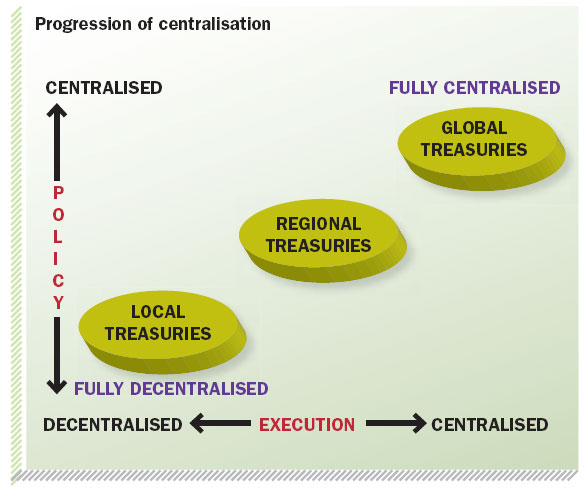
Where, then, do regional treasuries fit into this trend of centralisation? Centralisation or decentralisation is not an either/or decision, and companies can find themselves anywhere along the spectrum from one extreme to the other, with some elements centralised and others not. The illustration on the following page shows how treasuries can be organised according to two major parameters: policymaking and execution. A regional treasury can fit into this gap between local and fully centralised.
There can be many reasons why companies choose to remain wholly or partially decentralised and not all global treasuries centralise policy and execution. For example, a Europe-headquartered company with many market transactions to execute arising from Asian trade is likely to have a locally centralised treasury in Asia to manage those transactions in the time zone. In such a case policymaking may be centralised in Europe, but execution managed locally.
Exactly how a company chooses to structure its treasury will depend on factors such as the size of the company, industry norms, the nature of the business’ cashflows, its geographic distribution, its business culture, its use of technology, the location of its expertise, the need for control and regional treasury centres.
Regional treasury centres can operate effectively in both centralised and decentralised organisations. Their primary role is to assist the group and its subsidiaries in identifying treasury risks and liquidity and managing them effectively in accordance with group policies.
The regional treasury focus is on geographical areas and currencies. The responsibilities of the regional treasury centre span the subsidiaries and product groups within that area.
Increasing pressure on treasury for greater control and efficiencies has led to the formation of a structure of regional treasuries that may previously have been unrelated.
The role of the regional treasury centre is to work with the operations and, in a centralised structure, the group treasury in the following areas:
• assessment and control of the treasury risks faced by the company and how these are affected by the business
• country by country banking reviews
• development and day-to-day management of in-country cash pooling
• assistance and support for new companies as they join the group to establish appropriate treasury arrangements.
In a centralised environment the regional treasury centre may also be required to act as the regional in-house bank. Historically, regional treasury centres have been perceived as tax-driven structures.
More recently, however, companies are beginning to separate tax structure/location decisions from operational treasury centre location decisions for the following reasons:
• to be effective, the regional treasury centre needs to be in the region it supports and close to the key business operations in that region
• the location must be cost-effective. Staff, office space and other inputs can be expensive in tax-favoured locations
• high-quality treasury expertise must be readily available
• the location must be politically and economically stable
• the regional treasury centre is best sited in
a robust banking and stable regulatory environment.
Some companies have tried to run a regional treasury operation from outside the region. For many non-cash management functions, such as exposure management, this can work. For cash management, however, it is a sub-optimal solution for the following reasons:
• time zone differences can result in contact difficulties with subsidiaries and banks
• local cut-off times for clearing systems mean that sameday value transactions may not be possible from outside the region
• traditional regional treasury relies on local market expertise. It is not always possible to provide this level of expertise outside the region
• foreign currency markets may not be as deep or competitive outside of the region (for example, dealing Asian currencies in the US)
• negotiating pricing in the region will normally mean getting better bank pricing than outside
• regional treasuries are often able to take advantage of lower staff costs (as in India) compared with taxadvantaged locations.
TREASURY CENTRES
A treasury centre (as opposed to a regional treasury) is a centralised treasury management function which is legally structured as a separate group or entity. It provides financial management and transaction services for other group entities and is usually located in a tax-efficient environment. If the company is going to avail itself of any of the structures described above, such as an inhouse bank, a payment factory or netting service, the treasury centre would be responsible for implementation and ongoing management. It is a form of shared service centre for treasury services. The transactional areas for which it is most likely to be responsible are corporate finance, funding, FX and FX hedging, short-term investment and borrowing, cash management, accounts receivable, accounts payable and trade finance.
It is likely that the treasury centre will also be tasked with strategic roles such as establishing policies and guidelines for treasury, risk management policy, liquidity planning, organisational structure, systems planning, tax and regulatory review and planning, and bank relationship management.
In addition to the treasury centre having all the advantages (and disadvantages) of a centralised organisation, its location can bring additional important tax benefits by operating in and allocating profits to low-tax countries (with an eye to transfer pricing regulations).
MAKING THE BUSINESS CASE
Implementing a treasury centre is a major undertaking, both in terms of cost and resources. The business case can be difficult to prepare and some benefits, while not quantifiable, are of undeniable value to group treasury and the company as a whole, such as increased control and better risk management. Analysis of the benefits can be made by calculating a percentage of the value of cashflows that can be offset (i.e all intercompany cashflows that can be matched) through the treasury centre. This is usually comprised of the following:
• expert negotiations (with banks on deposit and lending rates)
• elimination of foreign exchange commissions (foreign exchange matching, netting, factoring or re-invoicing, trading larger blocks of currency less frequently)
• elimination of bank spread on borrowing and investing (notional pooling and cash concentration, intercompany loans and deposits).
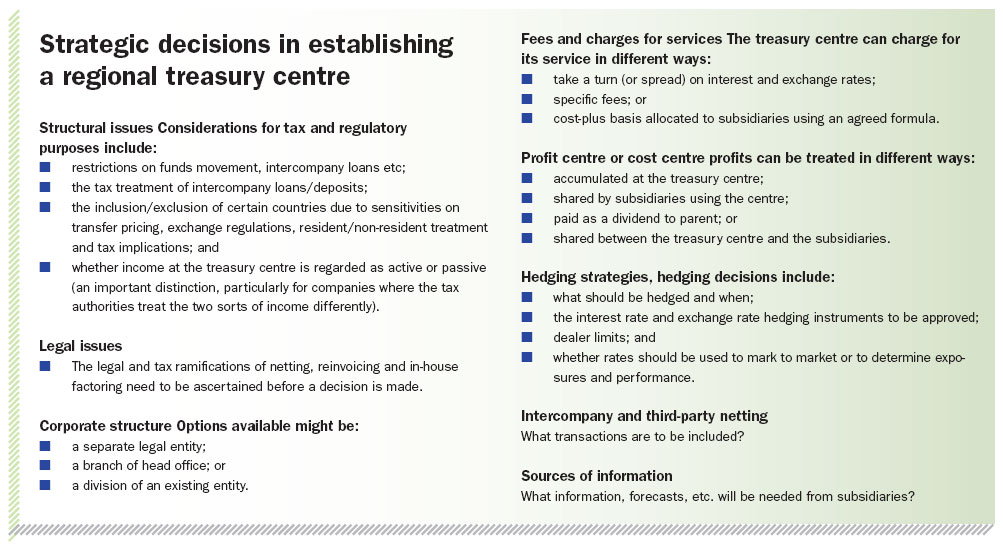
A number of decisions have to be made internally before the treasury centre can be set up. Some of the most important areas to determine are shown in the box below.
STAFFING THE CENTRE
How many staff will be needed to run the treasury centre? Should this be run inhouse or outsourced?
The two options are:
• Outsourcing. This may suit companies with a relatively low level of activity in a region, or where much of the work can be put on auto pilot – i.e. the bank does zero balancing or cash pooling, and regularly remits funds back to the home country.
• In-house operation. Running a treasury centre in-house may mean having to meet local regulations on staffing levels, or even location, in some low-tax countries. This is likely to be a more expensive option but will ensure maximum flexibility as to how it is structured and managed. Having a treasury centre does not necessarily mean having a huge treasury staff. Some of the largest multinational corporations, with the right technology and structure, are able to manage the treasury with as few as five dedicated staff at the centre, supported by one or two people in each region. Obviously, automation and straight-through processing are key here. Ideally, the treasury centre should not be involved in day-to-day transactions but concentrate on the strategic elements of treasury such as risk and liquidity management.
Will Spinney is ACT technical officer for education, wspinney@treasurers.org The second part of this feature will consider the pros and cons of specific locations for a regional treasury centre and whether it should be run as a profit or cost centre.