


Maki Vekinis of Cash Management Matters (CMM) sets out to explain what appears to be a paradox
The aim of this article is to address the cash management paradox – ie, why do banks offer a proposition that reduces
core revenue?
With Middle East-based banks focusing on alternative revenue streams through the offering of transaction banking products – following on the footsteps of the global banks who monopolised this business until recently – the above paradox will begin to dominate the decisionmaking process and is bound to influence how the business case for investing in cash management
products and services is constructed.
Initially, when we first approach the question, we do not see an immediate, simple answer to the fact that the aim of cash
management solutions offered by banks to their corporate customers is to increase efficiencies and, thereby, reduce their working capital requirements.
In addition, when a bank introduces, as part of the cash management suite, liquidity management techniques aimed at off-setting negative balances or offers account pooling to increase performance on aggregate balances, the negative effect on a bank’s revenue is measurable and quantifiable.
For example, a reduction of just 10 per cent on working capital through accurate forecasting of receivables and just-in-time sTP (straight Through Processing) payment scheduling,could translate, in a company with $8 million working capital, to a reduction in the loan servicing fees of approximately $200,000. Or, concentrating collections balances and taking a medium- to-long-term position on the core portion could translate into additional earnings of approximately $500, 000 on daily average balances of $5 million.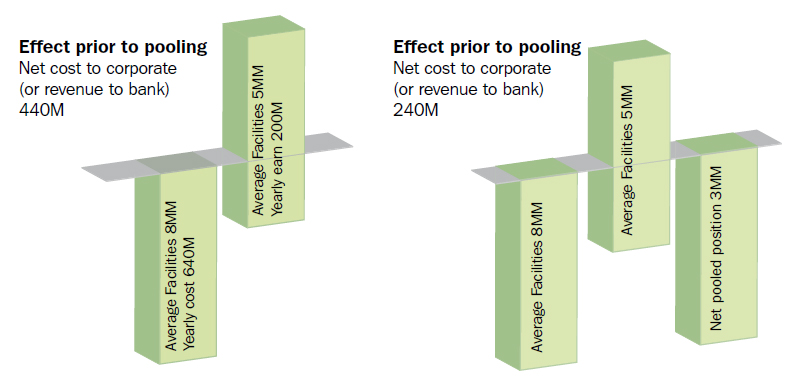
Surely, no banks can afford to provide services that have a negative impact on their earnings, in both MM & FX (Money Market and Foreign exchange) trading and also on the loans portfolio. Banks are not charitable organisations but businesses like all others that strive to increase stable and predictable earnings. even if we take into account transaction fees, these are never sufficient to offset the revenue loss described above.
For example, assuming a bank processes, for a fee, 5,000 payments/year for a large corporate operating expenses and supplier payments, in both domestic and international, it realises revenue of only $25-40,000. Or, an alternative view of the same when the average payment value is $10,000, we are looking at a total value of $50 million in payments for revenue at less than 1/10000 to the $. Pretty meagre results considering the investment in systems and technology required to provide the
service.
Well, is there a catch somewhere in the process? Is this a case of “too good to be true” or we should try to find how a bank compensates the revenue loss from the cash management solutions offered? Obviously, knowing how a bank mitigates the revenue loss can help treasurers of corporates manage and negotiate their relationship on much stronger terms.
Before we can answer the above questions we need to take a look at a typical bank’s operation and specifically the treasury, which is responsible for maximising the performance of customers’ as well as its own balances and currency/ commodities trading.
The optimum methodology for the treasury function is to maintain a balanced “book” with equal measures of MM, FX, commodities trading, coupled with investments in cash, funds, bonds etc. and in order for a treasury to achieve desirable pricing, it needs the volume in all aspects of its operation.
Therefore, a bank that attracts customers with large transaction flows, through the offering of sophisticated cash management solutions, increases its ability to be a market/price maker.
And the obvious corollary of the above is the spread between pricing offered to the customer and pricing achieved internally can sometimes exceed two per cent, three per cent or even four per cent depending on the currency and tenor. In addition, on the FX and commodities trading, even if it is offered at inter-bank rates, there are always few basis points’ revenue achieved on volume (this is in extreme cases of a very profitable relationship; typical corporate returns on FX volumes are around 10-20bps).
This simple description of the workings of the treasury function in a bank indicates not only a strong correlation of cash management volumes with treasury earnings but give us a strong hint as to the actual underlying business proposition.
But the above is not the only valid reason for the decision; after all, offering cash management requires sophisticated systems integrated in the bank’s environment as well as electronic channels for the customer to submit transactions and receive information – altogether a very expensive operation. surely there must be additional reasons for the revenue erosion that a bank is prepared to accept when it engages in the cash management business?
In order for us to answer the last question, we need to understand how a bank manages its portfolio of loans for its corporates. It is a well known fact that the larger the customer the less reliant a bank is on an external credit scoring system; instead, it utilises internally created and calibrated tools to arrive at the risk profile, which in turn is used to arrive at the loan rate. These tools, designed to price corporate credit risk, require detailed information on multiple aspects of a corporate business. And that is where explicit (as compared to implicit or as advised) information is achieved for corporates utilising cash management products and services. This means visibility of inflows/outflows coupled with monitoring, improved gearing and loan portfolio quality.
Although the above are two among many other reasons for a bank to offer cash management services, they are the most significant
contributors and easily address the underlying question of this article: “how do we explain the cash management paradox”?
We can immediately see why and how a bank that has achieved economies of scale through sTP is hungry for transaction volumes and balances and is prepared to invest in both the underlying infrastructure as well as the relationship itself to ensure a predictable
revenue stream is achieved and maintained.