

Senior leaders in the region are taking solid steps to set up ‘next generation’ business models in correspondent banking. ALEXANDER R. MALAKET, CITP, looks at how what is happening today will shape ‘tomorrow’
The global financial crisis, which has had – and continues to have – implications of varying degrees of seriousness across the globe, has indisputably resulted in a re-examination of the role, motivations and business practices of banks and certain financial services organisations.
Banks are fundamentally important to the smooth conduct of business, the creation of economic value and the facilitation of commercial enterprise, domestically and internationally. As a direct result of the global crisis, they have been driven to examine their value propositions, business models and client relationships, as well as the partnerships and alliances they maintain in support of their business.
While the MENA region was less directly affected than other areas by the financial sector issues that led to the global crisis, the increasingly inter-related nature of financial activity results in an imperative to advance and evolve business models, particularly in support of international activity.
As with other global regions, businesses in the Middle East have had to look beyond traditional consumer markets in Europe and the United States, and have sought opportunity in regional trade and cross-border activity, while concurrently looking to create and pursue commercial activity in emerging markets and with new economic powers.
Relatedly, banks and financial institutions have sought to extend their cross-border capabilities in response to changing commercial realities and evolving needs and demands from customers.
The way in which banks select, manage and maintain relationships with other banks – correspondents – has taken centre-stage, and is evolving in ways that are observable and have direct impact on solution and service delivery to end-clients.

Chris Fellner, head of international banking and executive management member at Doha Bank, observes, “The trade and commercial patterns in Qatar are such that traditional reciprocity models in correspondent banking are not easily applicable. Nevertheless, a good network is essential to support client-driven business such as payments and documentary credits, as well as to assist Doha Bank with our treasury management requirements.
“The cost of maintaining FI relationships is increasing tremendously, and our approach is to be more strategic in our selection of such relationships.
“Bundling of business and services is effective for our requirements. We are not transactional in this respect, rather preferring a win/win approach to relationships with selected institutions. Our approach to managing FI relationships is also shaped by the realities of regulatory requirements, which demand unprecedented levels of trust and transparency between partner institutions.”
Traditionally, banks might seek to maximise the number of correspondent relationships to increase their reach and service options. Under current conditions, they are far more conscious of the cost of maintaining such relationships, estimated to average about €15,000 per year even for basic relationships.
 More importantly, the regulatory demands on bank relationships – with corporates and with other banks – such as the “Know Your Client” (or KYC requirement) along with various anti-money laundering and financial reporting requirements, makes the demands of maintaining correspondent relationships significantly more complex, time-consuming and costly.
Major financial institutions might maintain thousands of bank relationships. However, there has been an imperative to rationalise such relationships, and to look more strategically at the whole model of correspondent relationships, how such relationships fit into the broader direction of a bank and its business, and ways in which clients are most effectively supported by a bank’s correspondent relationships.
SWIFT has argued in a recent white paper titled Correspondent Banking 3.0 that the industry must shift from a bank-product centric approach to a client-centric and experience-based model to correspondent banking, which SWIFT refers to as “experience banking”.
The paper argues that there are three “categories” of banking relationships: Partner Banks, working together on the basis of true synergies; Specialist Banks, selected for product-based specialisms; and Coverage Banks, meant to extend geographic reach in support of end-client requirements.
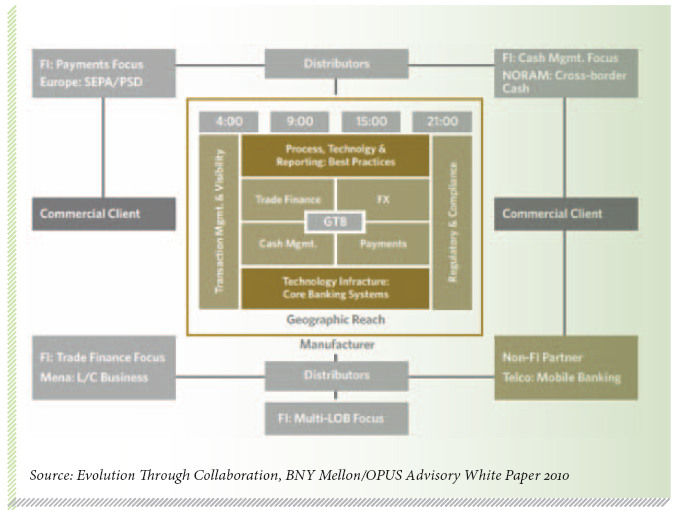
The evolution of bank partnership and alliance models was, likewise, explored in a 2010 white paper published by BNY Mellon and co-authored with OPUS Advisory Services. The paper posits a “manufacturer/distributor” model of bank alliances, where global or quasi-global institutions provide infrastructure, best practices, global reach and other support and capabilities, including access to a high-value network or ecosystem, while local or regional institutions bring the client proximity and all-important intimate knowledge of end-clients and local markets to the partnership.
Both papers reflect an evolution in the value proposition, strategic approach and business model around bank-to-bank relationships.
Senior bankers in the MENA region likewise reflect a significant shift in perspective and strategic outlook around correspondent banking and FI relationships.

Sami Ragheb, head of financial institutions at Bank Al Bilad in Saudi Arabia, notes, “Correspondent relationships have become increasingly strategic for Bank Al Bilad as we seek to significantly grow our international activities, including our trade finance business.
“In fact, the FI business has become a profit centre with solid growth targets. We are taking a ‘total relationship’ approach to selecting, managing and growing our FI relationships in the context of oil and infrastructure-driven growth in the Kingdom, increased regional trade flows, and a highly disciplined regulatory environment.
“Our approach is that the FI Team within Al Bilad must be innovative and solution-oriented, capable of driving significant capability for our clients and significant business for the bank. We will continue to take a prudent approach to risk, carefully monitor our capital position and ensure that we leverage risk participation and secondary markets to maximise our ability to respond to client needs.”
Specialists in this business are very aware of the ongoing influence of the global crisis and demands in many circles – business, consumer and political among others – for sound stewardship in financial services. The Middle East emerged from the crisis firmly positioned as a region whose bankers remained focused on the fundamentals, and avoided being caught in the worst of the crisis. Correspondent bankers express optimism about the value of and potential for FI business, but will warn against over-reaching, both in terms of capabilities and in terms of physical presence or reach.
There appears to be agreement about the need to invest in developing effective FI networks and value-adding correspondent relationships, as well as the imperative to invest in technology, delivery platforms and an appropriate mix of product and solution offerings, whether those investments relate to payments platforms, or sanctions-checking technology (and the related human capital and skillsets).
Technology is perceived as a critical enabler of leading-edge solutions, but also an important contributor to improved transparency, data-sharing and information flow, whether that is between banks and regulators, amongst the banks or between banks and corporate end-clients.
Correspondent banking is an area where demand for Islamic Banking competencies, capabilities and solutions has been described as “huge” in the MENA Region and in other parts of the globe.
One senior executive noted that this level of demand will require banks to be creative to better address the commercial needs of clients, while ensuring that Shariah compliance remains assured in the process of devising new solutions for FI and for corporate end-clients.
Relatedly, certain financial institutions will be very selective in their choice of products and services accessed or offered through partner FIs: the core question for some will be whether local clients require comprehensive product and solution sets from global FI partners, or whether more focused suites of solutions are appropriate.
Overall, there is a strong sense of potential around emerging models of correspondent banking, globally and specifically in the Middle East and North Africa. FI executives are reporting growth in budgets, resources and business scope and objectives, as well as an increased appreciation for the role of FI networks as enablers of corporate and commercial business, but also attractive business between banks, as well as non-bank financial institutions.
The growth trajectory of FI business in the region may be somewhat restrained by limitations linked to balance sheet size and characteristics, as well as regulatory oversight. However, local and international bankers will partner to support large infrastructure deals in the region, oil and non-oil trade flows, and other business, doing so partly through greater focus on risk-sharing and asset distribution.

K.P. Sunil Rao, regional head, FI MENA at Barclays Corporate in Dubai, comments, “We have certainly seen a consistent flight to quality in client and FI relationships, and, in the correspondent banking space, observe that regional banks are focusing on fewer FI relationships and definitely now making transaction and relationship decisions based on relationship commitment, quality of service and business value added with pricing now becoming a far less important decision criteria.
“In the MENA region, we see that commitment to the market, presence and consistency are characteristics that are valued and respected among our clients and partners alike. At Barclays, we are very focused on achieving the status of ‘trusted advisor’ and, in the FI business, this means we take a long-term, cross-product, needs-based and solution-orientation approach, with a commitment to sharing intellectual capital with our partners, as evidenced through our symposium series.
“Besides focusing on our theme of consistency and regional and relationship commitment, it includes training initiatives, hosting product roundtables, and providing on-the-job training to fellow bankers. There is a degree of consolidation of FI relationships in the MENA region, as is the case globally, and, in this context, we strive to ensure that the FI aspect of Barclays’ overall value proposition is clearly contributing to the needs of our clients and our correspondents.”
The global financial system may be on the cusp of significant transformation, driven by the lessons of the global crisis, and, perhaps, influenced (even indirectly and behind-the-scenes) by those regions least drawn into the imprudent practices that unleashed the crisis on the world.
On the other hand, talk of transformation may be nothing more than self-preserving lip service – but it is clear that correspondent banking and FI relationships can rise from the crisis with a level of profile that extends far beyond that of a utility business or a supporting function, to become a true centre of influence in shaping the future of relationships between banks and between banks and other types of financial institutions.
Senior leaders in the MENA region have taken concrete steps to shape their “next generation” business models in correspondent banking, and it will be valuable for corporate executives to understand developments in this arena, as the partnerships taking shape today, will affect the way banks service their end-clients tomorrow.