
When it comes to international trade finance, the aim is to create ‘smoother sailing in rough waters’, says FRITZ vom SCHEIDT, managing director of Tricon Trade Management Trade finance originates from the financing, or investment in, the import/export of goods, and it is an essential activity in global commerce.
Moreover, because a focus can easily be maintained in compliance with the Shari’ah, it has long been a mainstay of Islamic finance.
So, first, it is important to look at the fundamentals. Here is a quick illustration: an importer in one country buys goods from an exporter in another country; the importer’s bank issues a letter of credit to the exporter’s bank; and the terms of the letter of credit call for payment to be deferred for six months after acceptance to allow the importer time to sell the goods through his usual distribution channels.
Because such transactions are largely underwritten by bank-issued letters of credit that require clearing through a bank documentation department, trade finance assets have traditionally been the preserve of commercial banks, with the payment acceptances taken onto banking books following the delivery of trade goods to corporate clients.
As a result, despite trade finance having some excellent investment attributes, a great deal of this activity and information has not migrated to the mainstream investment markets.
Tricon’s introduction to trade finance investment began more than 20 years, when a client in South East Asia asked us to develop a programme to increase liquidity for US$ several hundred million in letters of credit taken annually onto the balance sheets of the family’s companies for their sugar exports.
To our pleasant surprise, we found ready investors among the global trade finance banks.
Above that, we noted that even when the letter of credit acceptances originated from the emerging markets, once the investor banks had priced the political risk of the issuing country and the credit risk of the guarantor bank into their yield, they were far less concerned about the future performance of their trade finance assets as they were about their other emerging market exposures in equities, bonds and real estate.
This, we learned, was grounded in historical performance. Banks have always considered trade finance instruments to have a priority payment status of “preferred payment for essential goods”, should a country experience limitations in its international currency reserves. This is because countries must pay for essential goods, or the flow of them dries up.
When Tricon began to analyse the trade finance “asset class”, we found that trade finance instruments had substantial liquidity because they are issued globally under uniform banking practices: usually, letter of credit acceptances, notes, bills of exchange or collateralised payments. The resulting assets are endorsable, transferable and typically guaranteed for unconditional payment of specified amounts on specified due dates.
In effect, because trade finance instruments are utilised to guarantee the cross-border shipment of goods and commodities by substituting the importer’s credit profile with the greater credit stature of the guarantor, there is always full transparency of creditworthy obligors. Usually, these are sovereign; state-owned entities; financial institutions; and multi-national corporations.
The fact is that banks actively participate in risk sharing in trade finance markets that are:
• well established, with current markets operating for more than 50 years
• sufficiently large, with estimated annual volumes approaching US$ several trillion in the primary markets and US$ 100 billion in the secondary markets
• liquid, with trade finance assets taken up by most of the world’s major banks
• global, with trade finance assets originating from all parts of the world, and being taken up in the banking markets in all major financial centres.
Banks are willing to participate in the instruments, particularly where yields are greater in the emerging markets, because the instruments offer inherent risk management in the form of the:
• close connection with the underlying necessity of importers/guarantors making preferred payment for essential goods
• the relative simplicity of banking documentation
• the readily available credit assessment of transparent obligors/guarantors.
On the basis of this initial information, Tricon more than 10 years ago began to develop trade finance investment portfolios for institutional investors, tailoring the inherent risk management components to meet the primary objectives of:
• conservation of capital
• LIBOR-PLUS returns
• The above combined with the inherent risk management derived from the underlying necessity of importers/guarantors making
“preferred payment for essential goods” and continuing trade flows.
We also diversified our portfolios in shipments of goods in compliance with the Shari’ah and determined valuations in accordance with AAOIFI principles.
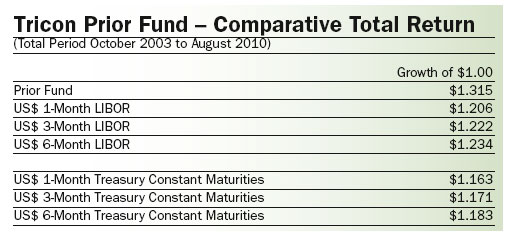
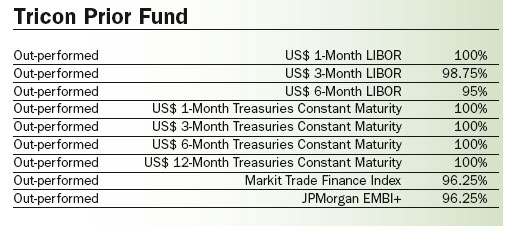
As expected, with more than US$ 100 million under management beginning in October 2003, the most recent Islamic Trade Finance Fund consistently out-performed its comparable benchmarks, including the following net returns:
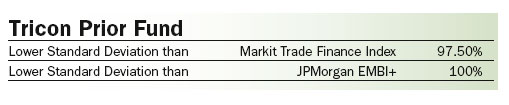
Moreover, during its 80 months of continuous operation, Tricon’s most recent Islamic Trade Finance Fund exhibited reduced volatility and minimal correlation, as measured in its month-by-month standard deviation, with the market as a whole, as represented by the Markit Trade Finance Index and with the emerging income markets, as represented by JPMorgan Emerging Market Bond Index+.
Through comparative tracking and analysis, Tricon also established that trade finance instruments exhibited lower volatility than most bonds or syndicated loans with the same country/credit risk because their payments were insulated in varying degrees from:
• political risk in country of issue
• economic risk in country of issue
• regional market volatility
• global interest rate movement.
Tricon also found that volatility and correlation were further mitigated by the fact that the trade finance asset class is concentrated in maturities largely limited to less than three years, and often less than one year, which greatly reduces the influence of:
• fluctuations in long-term interest rates
• other external factors, such as movement in equities markets
• macro-economic factors, such as changes in GDP or inflation.
With trade finance instruments, it is estimated that 20 to 60 per cent of the yield can be derived from a political/country risk margin, so asset yields do not move fully in tandem with the fixed-income markets.
In essence, while no investment is without risk, trade finance instruments are among an issuing country’s instruments where the risk can be largely identified and evaluated in advance so that it is possible to identify assets having investment yield in excess of risk. This additional yield, factored into the asset’s political/country risk margin, often provides an arbitrage opportunity to acquire medium-term yields using shorter-term assets, and this naturally provides an opportunity for excess risk-adjusted return.
Tricon saw this in its own portfolios in the following risk adjusted returns:
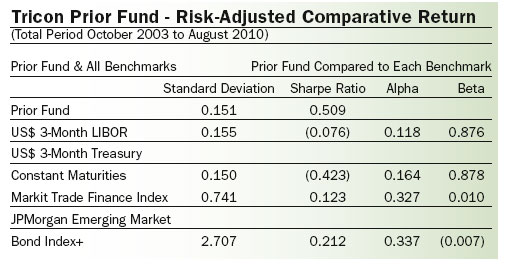
In addition to the monitoring of our Shari’ah supervisors, our asset selection process within our Islamic Trade Finance Fund portfolios concentrates on indentifying alpha in advance of investment to maintain an efficient frontier within the portfolio. We also utilise a long-only investment strategy without leverage.
As a result, we found that, not only was the alpha “portable” to some degree, but the beta was “blendable” with other asset classes such that the trade finance assets could be used to absorb some of the volatility of other assets classes and reduce the overall volatility of almost any portfolio.
For Tricon, what began as arranging financing for commodities export shipments has evolved into a strategy and process for investment in the shipment of goods in compliance with the Shari’ah, allowing us to capitalise on the unique opportunity of an alternate asset class for smoother sailing in the rough waters of today’s uncertain markets.
F. W. vom Scheidt is the managing director of Tricon Trade Management Limited, the Bermuda-based investment manager of Tricon Forfaiting Fund Limited. He can be contacted at fvomscheidt@globaltricon.com .