
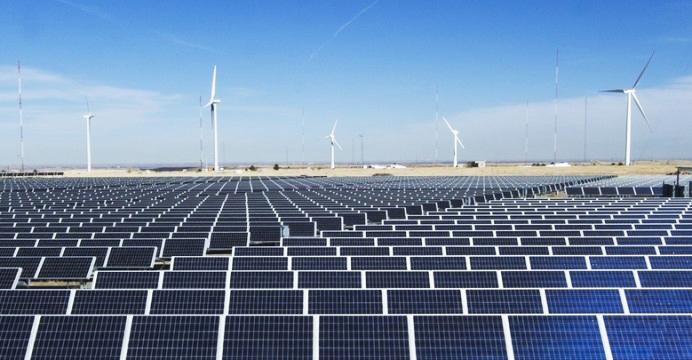
With an extremely favourable climate and ample available land, the GCC countries are well placed to benefit from a global rise in solar power. Rachel Goult, director at S&P Global Ratings, considers the GCC’s efforts to become a large producer of solar energy – and how new capital market involvement and green Islamic finance initiatives could help support the growing industry
Over the past decade, sharply declining costs have spurred renewable energy growth. So much so that, according to the International Energy Agency, renewable generation will grow at twice the rate of gas and coal combined for the next five years.
For example, the cost of solar photovoltaic (PV) modules has decreased at an average annual rate of about 10% since 1980, according to Oxford University. Meanwhile, the International Renewable Energy Agency (IRENA) states that in 2017 the modules were more than 80% cheaper than in 2009. And with solar becoming less expensive than ever before, the sun is starting to rise on the solar power industry in the GCC.
A major opportunity
In line with rapid population growth andongoing investments in energy-intensive industries, the GCC’s energy consumption has increased substantially in the past two decades. The growing regional ambition for greater solar capacity is, therefore,timely.
The GCC enjoys two factors crucial for efficient and economically viable solar electricity generation: high solar radiation levels year-round, and large amount ofland (especially in the sparsely populated desert). Notably, for many other countries, using land for solar installation typically presents a big opportunity cost. The land could be used for farming, industry or cities, for example. However, given the vast swathes of available, barren land in most GCC countries – particularly in Saudi Arabia and the UAE – the opportunity costs are low.
Moreover, if GCC nations meet their solar energy targets, they could save huge amounts of oil and gas – which couldinstead be used for either local consumption or domestic petrochemical industries.
Supporting investment
Solar is a strategic priority for investment. As such, a number of large-scale products have been announced by GCC member nations over the past few years. In March 2018, the Saudi government and Japan’s SoftBank Group Corp announced plans to build a solar project that will have an annual capacity of 200,000 megawatts (MW). Expected to cost US$200 billion through 2030, this project is several times larger than any other solar projectglobally.
Meanwhile, under the Dubai Clean Energy Strategy 2050, the Emirate of Dubai plans to gradually increase the relative weight of clean energy sources to 75% by 2050. It has also begun building the Mohammed Bin Rashid Al Maktoum Solar Park, which will target generation capacity of 5,000 MW upon completion in 2030.
The Emirate of Abu Dhabi has similar aims. Under construction is a large-scale solar plant in Sweihan, which will have a total production capacity of 1,177MW. Elsewhere in the region, Kuwait also announced plans to produce 15% of its power from renewable energy by 2030, while Qatar is overseeing the building of a 200 MW solar plant, with anexpansion plan of up to 500 MW.
Potential financing
The list of projects shows lofty ambitionsand it is hard to tell how many will actually be developed. Nonetheless, theGCC will see massive investments in solar PV over the coming years. Local and international banks have financed the majority of projects thus far. Mainly, this has been because banks are very accommodative of large transactions – offering very attractive pricing level and terms. That said, we believe that capital market (and project bond) activity may soon increase – especially because recently announced projects are onlygrowing in size.
Given the high decarbonization potential of new solar capacity, some issuers and banks might also look to the green bond market. And if they do, we believe that GCC issuers may combine green and vanilla sukuk features in any green financings they undertake, effectively tapping into two distinct liquidity pools. In turn, this will likely attract a more diversified investor base, as is typical of green financings.
In 2017, Malaysia-based Tadau Energy became the first green sukuk issuer – raising 250 million Malaysian ringgit in funding for a large-scale solar project of 50 MW. There have since been further green sukuk issuances in Malaysia and Indonesia, though we expect more GCC-based issuers to follow suit over the next two years. There is potential also for GCC bank financing in a smaller range (US$20 million to US$100 million – for example, for rooftop solar and executed over several tranches.
At a time when the global renewable energy industry is growing strongly, the GCC is increasing its solar capacity. In addition to falling module costs and technological advancements, policymakers are supportive, too, as plans to further combat climate change take precedence. As such, we expect significant regional investment in solar projects for the years to come.