
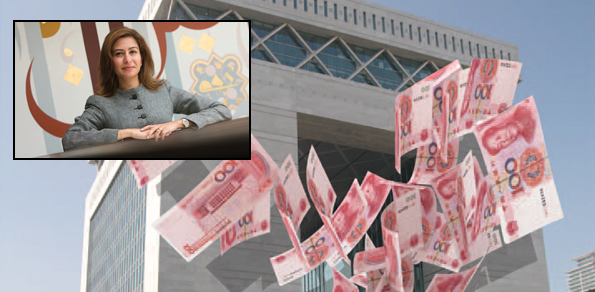

As it becomes a strategic hub for rising intra-emerging market trade flows, the Middle East is at an inflection point in its development. BNY Mellon’s Bana Akkad Azhari assesses the effect of evolving trade patterns on the region’s transaction banking provision and the role local-global bank collaboration can play in navigating the changes
Trade is synonymous with the Middle East. The region has long been defined and dominated by trade, but the emphasis is now shifting from intra-regional to international trade – and chiefly trade conducted with overseas developing markets. This is a key point to note, as intra-emerging market – or “south-south” – trade is now one of the main drivers of the global economy.
Indeed, according to the World Bank’s June 2013 Global Economic Prospects, more than half of developing country exports now go to other developing economies1 – and this trend shows no sign of abating.
Such a shift in trade focus from west to east is a key development for the Middle East, as its position between the growth markets of Central and Eastern Europe, Africa and Asia makes it a gateway for global intra-emerging market trade.
Asia is of particular importance – and not least because of China’s status as one of the original drivers of intra-emerging market trade, and the already well-established trade ties between China and the Middle East.
As China undergoes fiscal transformation – as it seeks to mature from being an export-led economy to a consumption-based economy – it is likely that new regional growth markets seeking to emulate China’s example will emerge to eventually become key international trade players.
As a result, the Middle East’s connections with Asia are set to increasingly expand beyond the world’s second largest economy. And research supports this view – a 2012 Ernst & Young report entitled Beyond Asia: New patterns of trade indicates that for most rapid growth markets in Asia-Pacific (mainland China, Hong Kong, Indonesia, Malaysia, Singapore, South Korea, Taiwan, Thailand and Vietnam), trade with MENA will grow faster than trade with the Eurozone over the next 10 years2.
The number of trade agreements between the two regions, which are increasingly moving beyond commercial oil ties to encourage mutual investment across a variety of sectors, further supports this. One such example is the April 2013 agreement between Qatar and Vietnam to promote trade co-operation and facilitate the exchange of commodities and services between the two countries.
Managing changing expectations
Such developments – and the wider ramifications of rising south-south trade – are having a profound impact on domestic corporates’ requirements and expectations, presenting the Middle East’s indigenous banks with a significant challenge.
Facilitating modern cross-border trade against a backdrop of ongoing liquidity constraints and unprecedented regulatory complexity can be difficult enough. But with commercial growth opportunities increasingly to be found in new, less familiar markets – in which transactions risks are naturally perceived to be higher – managing the trade process becomes even more complicated. Not only must the amplified risk be addressed, but so too must the commercial rules, requirements and levels of operational sophistication of the new markets in question.
With this in mind, it is easy to see why the region’s domestic banks – that may have yet to develop truly international reach and capabilities – could struggle to independently support their corporate customers’ efforts to tap into rising intra-emerging market trade.
That said, the Middle East – and its banking sector – has plenty working in its favour. A historically conservative region, many of its deep-rooted characteristics – such as a staunch emphasis on risk-mitigation – have stood the Middle East in good stead.
Indeed, its inherent conservatism is often cited as one of the reasons Middle Eastern banks escaped the global crisis of 2008 relatively unscathed – and it is equally likely to work in its favour going forward. However, the nature of modern international trade means such prudence will have to be combined with speed and efficiency if all corporate requirements are to be met.
Bridging the divide
The value placed on caution and security by the region has manifested in the continued popularity of traditional trade instruments such as letters of credit (LCs), despite the expense and complex paperwork they often entail.
The cornerstone of all banks’ trade finance offerings, LCs offers the most secure means of payment for sellers – providing the terms are followed to the letter – and has always been an area in which local banks have tended to dominate. This is because the majority of corporates would rather employ an indigenous bank for LC issuance in order to ensure the consigned LC is valid.
Today’s need for enhanced speed and efficiency – not to mention greater visibility and control over end-to-end transaction flows – mean that the risk-mitigating properties of the LC must now be combined with the ease, efficiency and cost-effectiveness of open account trade settlement.
However, given the cost and complexity involved, underpinning documentary credit capabilities with platforms that offer global reach, regulatory compliance across borders and enhanced processing may prove too tall an order for many local banks.
This is particularly the case when considering that trade solutions must come hand-in-hand with cash and working capital management solutions and, more specifically, multi-currency solutions. At present, such capabilities are largely the domain of specialist global providers – especially with regard to emerging settlement currencies, such as the Chinese renminbi (RMB) – but the Middle East is making notable headway in this respect.

the next offshore RMB trading centre
Dubai, for example, is edging forward in its bid to become the next offshore RMB trading centre (after Hong Kong and Singapore). Though Dubai is one of the region’s most advanced economies with respect to financial technology – in part because of the high concentration of international banks – innovation in this respect is likely to spread as local corporates realise the potential competitive advantages of the ability to settle in emerging currencies such as the RMB.
Leveraging global capability
Trade has long-been an international game and its growing complexity means it is increasingly becoming a specialist arena dominated by global trade and cash management providers. But local banks’ strengths – particularly in the Middle East, a region in which relationships and historical presence are greatly valued – means there is no reason why international players should dominate on home turf.
While local banks may not possess the same operational scope or level of functionality as their international counterparts, what they can offer in terms of home-market expertise, client understanding, and capability to address client concerns at in-country level is difficult to rival.
Replicating such strengths across borders – particularly in unfamiliar and challenging geographies – is a question of technology. And this is best achieved by partnering with a specialist provider of global trade and cash management services.
Certainly, such partnerships can capitalise on local-market expertise by making global reach and best-practice available without the need for proprietary – and often prohibitive – investment into network and solutions development.
Such support can help local and regional banking communities adapt to the growing demands for emerging-market connectivity, and help ensure that trade entities are in a strong position to effectively mitigate risk, optimise working capital and make the most of the opportunities presented by burgeoning intra-emerging market trade. n
Bana Akkad Azhari is MENA head of relationship management for BNY Mellon Treasury Services
Material contained in this article is intended for the purposes of general information only. It is not intended to be a comprehensive study of the subject matter, nor provide any treasury services advice, or any other business or legal advice, and it should not be used or relied upon as such. The views expressed herein are those of the authors only and may not reflect the views of BNY Mellon.
2 Comments
Banks gear up for more ‘south-south’ trade http://t.co/UJBdvHLZKp @BNYMellon #Dubai #Saudi #UAE #Lebanon #Kuwait #Bahrain #Qatar #Oman
RT @CashandTrade: Banks gear up for more ‘south-south’ trade http://t.co/UJBdvHLZKp @BNYMellon #Dubai #Saudi #UAE #Lebanon #Kuwait #Bahrain…