
 Against the backdrop of a slowly improving economy, corporates are once again focusing on growth. And the benefits of emerging markets are hard to ignore. Citi’s AMIT AGARWAL, treasury and trade solutions, liquidity management services head, EMEA; SYBIL CRASTO, treasury and trade solutions, MENA and Pakistan; and DIMITRIOS RAPTIS, treasury and trade solutions, liquidity management services market management head, EMEA, discuss how smart liquidity management can help companies grow safely into regions filled with both benefits and challenges
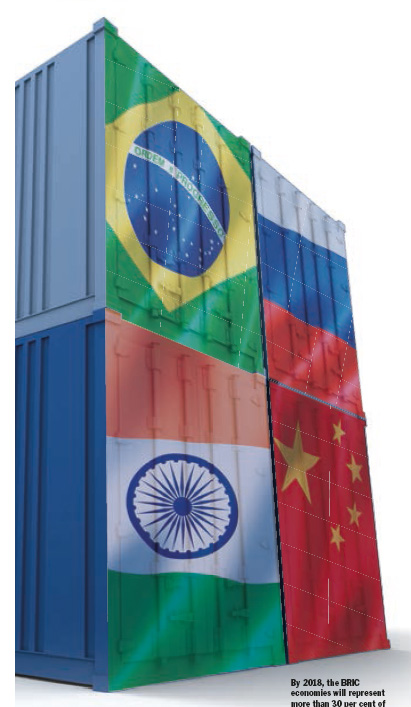 While the West has been struggling with the aftermath of the global financial crisis, emerging markets – in particular, China – have instead been busy growing. Indeed, it is expected that by 2018 the BRIC economies will represent more than 30 per cent of the total global output – making them larger trading partners than either the US or Europe.
Buoyed by this growth, the global economy is finally showing signs of improvement – prompting corporates to once again turn their attentions to multinational expansion.
Emerging challenges
And while advanced economies – particularly Europe and the US – still face significant challenges, emerging markets are likely to remain high-growth areas,
and, therefore, offer the most rewarding potential for expansive corporates.
Certainly, despite slowing growth, it is expected that China will surpass the US as the largest economy in the world by 2021, and the MENA region has observed strong growth due to continuing high oil prices.
Yet expanding into emerging markets is not without its challenges. Corporates will face regulatory, political, and economic risk, as well as less sophisticated physical, financial and IT infrastructure.
What’s more, it is essential to understand the nuanced cultural and social traditions of each region – particularly where it might impact business practices. Manual processes, for instance – although less reliable and often inefficient – are traditionally the preferred method of payments, collections and data control in emerging markets.

liquidity management services head, EMEA
This is especially true in countries that have less sophisticated IT infrastructure – adding to the more challenging financial and physical infrastructure as an obstacle to efficient business operations in such markets. What’s more, in some countries such as Russia the particularities of the local clearing system and the virtual absence of Real-Time Growth Settlement systems (RTGS) have adverse effects on local liquidity flows, and, consequently, on working capital.
Of course, there is also exposure to political risk. Emerging markets, and in particular the MENA region, have in recent years experienced significant political unrest – something that shows no sign of abating, and could have severe implications on companies that either operate or have counterparties in vulnerable regions.
Treasury centralisation growth
So how can corporates both reap the rewards of emerging markets and at the same time navigate the risks? One answer may be liquidity centralisation – a trend leading many corporates, from both advanced and emerging markets, to establish regional treasury centres in the UAE.
In order to grow, corporates need the liquidity to fund their strategy. Knowing where, and how much, cash is received, spent and indeed trapped is, therefore, imperative. Having this knowledge also strengthens the operational efficiency of a company – safeguarding it from exposure to external challenges.
Centralising liquidity processes not only allows corporates to streamline accounts and bank relationships – thereby simplifying liquidity-management practices – but also increases efficiency and control. Indeed, collecting payments and data into one single location – as opposed to multiple centres across emerging markets – increases visibility on a group level, therefore enabling corporates to know the liquidity available at any given moment.

solutions, MENA and Pakistan
And, of course, it helps to mitigate risk. Through the consolidation of flows, corporates concentrate their day-to-day operating balances and can manage counterparty FX and interest risk exposure, and execute hedging more efficiently – therefore, again, helping to protect against the challenges of the emerging markets.
Location, location, location
Certainly, while centralisation safeguards companies by adding efficiency and enabling them to manage counterparty risk, there is an additional way to mitigate the challenges posed by the emerging markets: avoiding the riskier regions.
It is out of an eagerness to avoid these particular challenges that many companies are choosing to grow using a hub-and-spokes approach to liquidity management: spreading business across the emerging markets, but at the same time carefully controlling and centralising all liquidity processes through a single regional treasury centre based in the UAE.
Despite being located in a region challenged by political unrest, the UAE is politically stable. The country is also immune from the threat of decreasing oil prices as the UAE is successfully diversifying its economy away from oil. What’s more, through its Free Zones the UAE offers a favourable tax and regulatory environment – meaning it encourages, rather than hinders, business.
Certainly, its advanced infrastructure adds another benefit. Most clearing systems are well-developed and offer extended cut-off times – therefore encouraging investment. The UAE also has a liquid USD market where the local currency is pegged to the USD, rendering FX risk as relatively low. Finally, there are no restrictions or FX controls.

solutions, liquidity management services
market management head, EMEA
Of course, the incentives to open a regional treasury centre in the UAE extend beyond simply avoiding the challenges of elsewhere. Situated not only between Africa and Asia, but also between Asia and Europe, the UAE is a trading hub for emerging markets – especially as China surpassed the US as the Middle East’s largest trading partner. Establishing a regional treasury centre in the UAE, therefore, not only allows a company to benefit from these growing trade links, it also means it is perfectly located to manage and control all of the company’s subsidiaries throughout the emerging markets – no matter how widely spread.
An emerging future
The benefits of centralisation are clear – as are the benefits of establishing a regional treasury centre in the UAE. Doing so, however – streamlining banking relationships, overhauling existing liquidity systems and enabling the seamless conversion to a regional treasury centre, as well as ensuring regulatory compliance – is complicated.
A large number of international banks operate within the Middle East, and collaborating with a sophisticated banking services provider, such as Citi – and leveraging the bank’s single global platform – can not only help corporates expand safely and efficiently into the emerging markets, but also allows them to take advantage of an extensive global network as well as local expertise.
Profiting from emerging market growth is a logical step, and improving liquidity management processes is imperative. Through the help of a sophisticated banking services provider corporates can establish regional treasury centres in the UAE, and grow into emerging markets in a way that enhances efficiency and side-steps risk.