
Dear Reader,
Roughly speaking, MENA bankers’ feelings about the imposition being placed on them by the US Internal Revenue Service could be summed up as follows: “We’re busy enough doing our jobs without doing yours as well.”

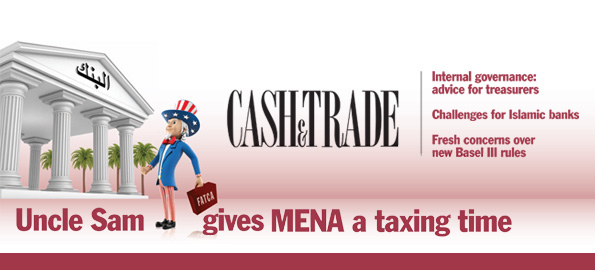
In this issue, we report on the implications that have sprung out of the United States Foreign Account Tax Compliance Act (FATCA), which requires all foreign financial institutions (FFIs) to report to the Internal Revenue Service on the activities of investors who are US citizens.
This has created a huge task for banks and wealth management companies worldwide – and the Middle East is no exception. As in other parts of the world, considerable concerns have been expressed about a “US regime” that will affect the operations divisions of all financial institutions (FIs) and bring substantial compliance costs.
“Effectively, this represents a move by the US Treasury to outsource part of its tax collection efforts,” says John Garrett, group chief compliance officer, National Bank of Abu Dhabi.
One of the biggest challenges FFIs face under FATCA is the huge administrative burden it places on them in terms of identifying US citizen investors; gathering information on their investment activities; and then reporting on them to the IRS. This is expected to generate hefty costs in terms of new processes and procedures; system changes; and additional resources.
The new FATCA regime is also likely to prove a testing experience for many Middle Eastern FIs because compliance with it is expected to contravene existing client confidentiality agreements as well as data privacy, and other laws, in many countries.
The costs and burdens that FATCA brings have also led to suggestions globally that FFIs with small US investor bases may consider that meeting its requirements outweighs the benefits of attracting US investors. According to industry commentators, many MENA banks are considering closing their doors to US citizens, especially if they do not have that many American clients anyway.
The introduction of Islamic banking into Oman is being greeted with caution by the authorities.
A Royal Decree issued at the end of last year by the Ruler, Sultan Qaboos bin Said, means that banks in Oman, hitherto the only GCC country not to have introduced Islamic banking into its jurisdiction, can now offer Islamic banking products to customers and businesses, subject, of course, to approval from the Central Bank of Oman (CBO).
But both the Omani government and CBO officials are careful not to raise unrealistic public expectations about Shariah-compliant finance in the nascent Omani market. Although there is quiet confidence that the sector will take off and, eventually, will increasingly make its mark in the Sultanate, for now it’s felt that the immediate challenge is “to manage the orderly development of the industry and the market in Oman”.
Qatari banks are now taking corporate banking and trade finance more seriously, according to the latest Tajara Monitor.
It found that both had been a business and product segment that many Qatari banks had been arguably too relaxed about for many years, regarding it as bread-and-butter business with limited scope for innovation and/or justification for new investment.
However, this is now changing. Several banks have continued to improve their capabilities on these fronts, and most have increased their focus on providing facilities to the SME sector whilst several also expanded capacity for the contracting and public service entities sectors and project finance.
More flexibility is needed to curb Basel III’s impact on global trade because there is a worry that its new rules will treat trade finance almost as harshly as much riskier activities. This is the view of Tod Burwell, chief executive and president of BAFT-IFSA. He speaks exclusively to Cash&Trade in this issue in what is the first of a series of high-profile interviews that we plan for 2013.
Finally, everyone at Cash&Trade joins with me in wishing all our readers a happy and prosperous New Year.