
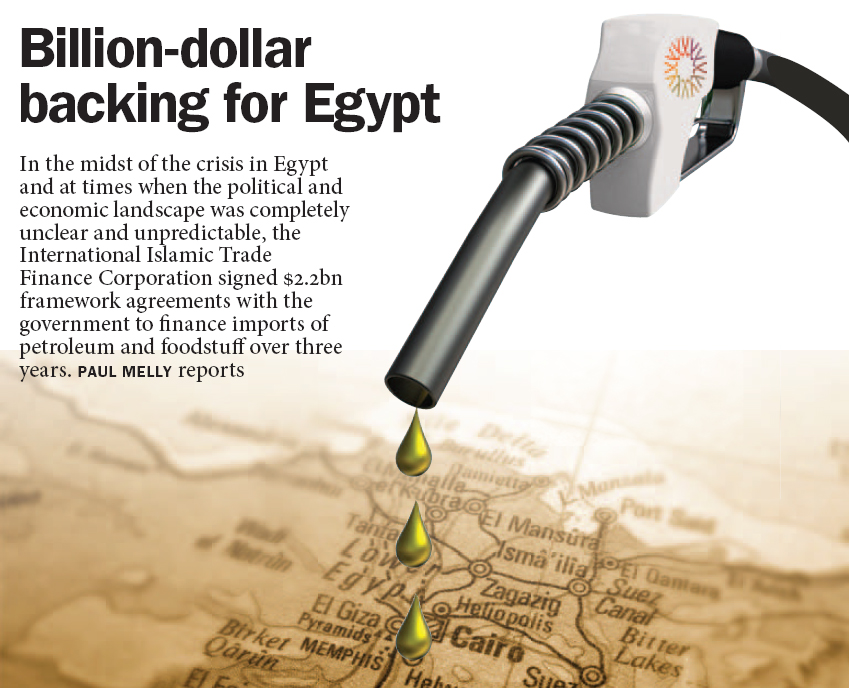
 In the midst of the crisis in Egypt and at times when the political and economic landscape was completely unclear and unpredictable, the International Islamic Trade Finance Corporation signed $2.2bn framework agreements with the government to finance imports of petroleum and foodstuff over three years. PAUL MELLY reports
Times of fragile confidence are the real tests of friendship. These have been tumultuous times in North Africa. And as the inevitably uncertain process of political change moves forward from one tense moment to the next, countries such as Egypt and Tunisia need to know that they have allies they can count on.
But at a time of on-going crisis in the global economy, there are not many institutions such as ITFC with the assets and strength to take a long-term view of trading potential and debt service reliability in a region undergoing change on the scale experienced by North Africa.
Understandably, with a new governing team barely in place and many of the key constitutional decisions yet to be taken, private sector banks and investors have little choice but to be cautious in their approach to Egypt.
A strong economic performance in recent years offers encouragement that the country will gradually be able to find its way back onto a path of solid growth and increasing competitiveness.
But, paradoxically, it also highlights the complexity of the situation: even as Egypt’s economy was expanding, with a wave of impressive export projects and financial sector reforms, social and political pressures were building up below the surface.
And for banks, insurers and investors that is a reason for taking a cautious line now. They need to see that current progress towards a reformed political stability and economic revival is well rooted and will be sustained.
Bridge-building role
So this is where an institution such as the International Islamic Trade Finance Corporation comes into play. It can provide funding and accept significant levels of risk exposure at a time when private sector financial players still have to hold back.
ITFC is an autonomous entity within the Islamic Development Bank (IDB) group. It was set up in 2008 to provide funding support for trade on sharia-compliant terms, and to promote “south-south” trade between countries belonging to the Organisation of Islamic Cooperation.
Hitherto, the IDB used to provide trade finance through a range of different facilities and credit windows. But these activities are now grouped under one umbrella – the ITFC.
The Corporation has been able to develop its own specialist expertise in this area, which is very different in nature from the long-term development project financing that is the mainstay of IDB operations. Its clients are both businesses and governments.

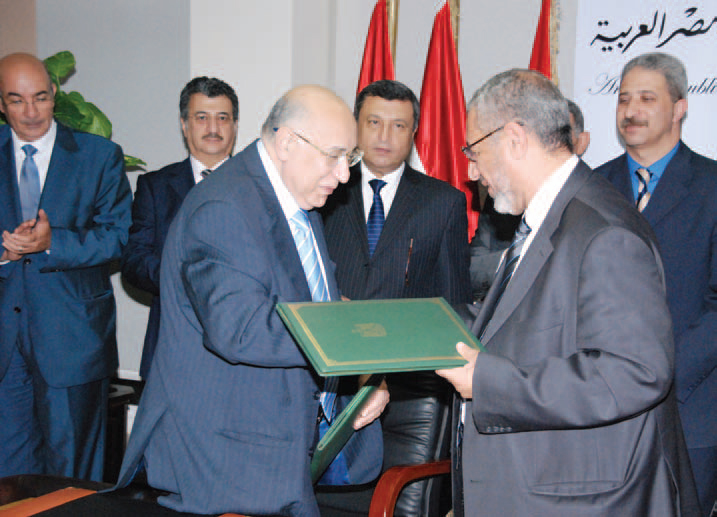
of the Board and Managing
Director of the Arab Investment
Bank, Egypt; Eng. Osama Kamal,
Minister of Petroleum; Dr. Mumtaz
Al-Saeed, Minister of Finance; Dr.
Waleed Al-Wohaib, CEO ITFC
Although it is providing Islamic trade finance – essentially a commercial product – the Corporation is also able to make use of its position as part of one of the world’s major development banks to get high-level access to governments; and to mobilise resources from the public sector as well as the business community.
Between 2008 and the middle of this year, the ITFC had already approved more than $1.7bn in financings for both government entities and private sector companies in the country. It also collaborated with the Egyptian Social Fund for Development to channel funding to small and medium enterprises besides direct trade financing for private sector importers of essential commodities such as wheat, maize and soy, including funds for the animal feed industry.
Indeed, the Corporation had committed itself to provide the Egyptian energy and food sector with $2.2bn in trade finance, through innovative sharia-compliant techniques.
So with this existing framework in place, ITFC was able to move forward with the next phase of funding for Egypt, even at a moment when the country was undergoing one of the most important political changes in its history.
Realizing its role and obligation to support member countries, the Corporation did not feel the need to hold back until this delicate process was over; it had the clout not just to maintain but to increase the flow of its financing support just when Egypt needed it most, and despite all the uncertainties that necessarily surround the election of a new president.
Having signed framework agreements with the Government of Egypt, ITFC will accordingly provide the Egyptian General Petroleum Corporation (EGPC) and the General Authority for Supply Commodities (GASC) with approximately $2.2 bn.
The facility will finance the import of strategic commodities including petroleum and during which products as well as wheat and other foodstuffs.
In fact, ITFC’s financing came in precisely at a time of political pressure, social tension and uncertainty which the new administration needed to be able to ensure reliable supply of fuel and food for the Egyptian population.
Demand for oil
Egypt is, in fact, an oil exporter. Alongside income from tourism and the Suez Canal, the sector is one of the main foreign exchange earners for the economy and the government. The oil and gas sector accounts for about nine per cent of GDP.
But the net outflow of petroleum and downstream products has shrunk over recent years, as domestic consumption of fuel has continued to rise in line with population growth and the slow but steady improvement in living standards.
Thanks to the rise in world energy prices, this ongoing decline in the volume of oil export shipments has not been reflected in terms of income. Revenues from the oil sector have continued to increase.
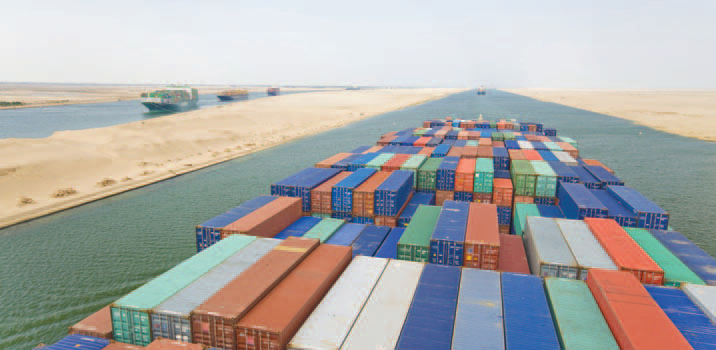
But the flow of petroleum products trade is two-way. Egypt also needs to import some items – to complement those produced at home. And this is where ITFC’s support for the sector remains key.
EGPC reports that right through the upheavals of the revolution in 2011, the Corporation continued to provide trade financing, which helped sustain the level of its imports as needed.
Last year ITFC and EGPC jointly implemented $308m in trade finance deals to fund purchases of petroleum products from other Islamic countries and this year this amount was more than doubled reaching $765m.
A higher profile
 In today’s Middle Eastern financial environment, the focus on sharia compliant financial products is thoroughly mainstream. Islamic banking has become not only a hugely popular vehicle for providing services to the mainly Muslim consumer population of the region, but also a major player in corporate, trade and project finance. ITFC since its establishment, and IDB before that, has been a major player in providing innovative and custom-built Islamic financing products.
Sometimes these products are provided directly to companies engaged in major import activities such as EGPC. On other occasions, and in order to reach a wider range of clients, it works in partnership with banks or other financial institutions to fund the provision of trade finance services.
ITFC’s particular focus is to assist and encourage Islamic countries to develop direct trading with each other and to build up their infrastructure to ensure smooth and efficient international trading.
The Corporation also helps drive down the cost of trade finance for local private sector businesses by providing financial services which would eliminate the need for third party banks and the cost associated with obtaining confirmation on Letters of Credit from these banks.
The Corporation is thus seeking gradually to enhance the cost competitiveness of trade within the region, exerting pressure to eliminate extra layers of cost, squeezing the profit margins of middlemen and sometimes enabling the main partners in a trade deal to exclude the intermediaries whose own costs and profit margins so often add to the overall cost.
But beyond helping squeeze costs, to enhance competitiveness, ITFC is also acting as a credible first stage source of funding for those countries and banks that have difficulty accessing any trade finance at all.
In doing so, it aims to bolster the overall volume of trade between Islamic countries, including those in the Middle East.
Portfolio to be diversified
Like most major financial institutions, ITFC realizes the need to review its approach in the wake of the global crisis. As a result, it decided to diversify its portfolio of activity by expanding the financing of agricultural and other non-oil trade.
As a means to achieve this, ITFC developed its own structured financing capabilities where the risk is underpinned by the value of commodities being financed, rather than by conventional government or bank guarantees. Further more, ITFC built strong partnerships with international and regional banks and financial institutions which ITFC leverages to attract funds from the market to participate in funding member countries.
A memorandum of understanding was, for instance, signed with the Bahrain-based Al-Baraka Banking Group to strengthen co-operation in providing trade finance through the group’s network of 300 branches in more than a dozen mainly Middle Eastern countries.
In the Islamic year 1431H (corresponding to 2010), ITFC raised $1,135m on financial markets to fund 15 trade finance operations for 9 countries, thanks to the credibility and strong partnerships ITFC enjoys with major global financial institutions.
This highlights the way that ITFC can use its status as part of the IDB group, with the strength to look beyond the narrowest risk parameters, to lead the way in financings and catalyse the mobilisation of funds from a broad range of sources who might have been unwilling to act on their own.
This role is particularly valuable at a time of change in parts of the Middle East and North Africa, where countries need continued access to trade finance at precisely the moment when many private sector lenders have become more cautious and reluctant to extend credit until they can see a track record from the new governments that have taken power.
The recent financing agreement with Egypt is thus particularly important as a signpost for the future, because of both its size and its three-year rolling timescale. Vindication for ITFC’s decision to back the country at this time of change and breakthrough should open up further opportunities in the future, both for Egypt and for the financing of trade in other Middle Eastern economies.