
Asia’s insatiable appetite for oil and gas has provided large and lucrative export markets for Middle eastern energy companies,which they have further capitalised on by building refineries and other facilities there. setting up business in asian countries creates numerous banking, cash management and regulatory challenges for treasury departments, but they can be resolved, explains LANCE T. KAWAGUCHI (pictured) of Citi.

Whatever problems last year’s global economic downturn might have created, one thing is for sure – it has not materially affected the long-term upward trajectory in demand for oil and other hydrocarbon products, especially from the asia–Pacific region.
Consumption of crude oil in asia–Pacific rose from 21.4m barrels a day (b/d) in 2001 to an estimated 25.4m b/d in 2009. This figure is expected to rise to 25.9m b/d this year, and to around 29m b/d by 2014. The principal importers will continue to be China, Japan, India and south Korea, with the Middle east supplying around half the region’s demand.
It is a similar story for natural gas. In 2009, the region consumed an estimated 459bn cubic metres (bcm) and demand of 582bcm is forecast for 2014. China’s estimated share of gas consumption in 2009 was 18.5 per cent and, by 2014, it is forecast to be 20.8 percent.
Middle eastern energy exporters have not been content simply to export hydrocarbons to asia. They have also built refifineries there to process the raw products, and other facilities, in joint venture arrangements with local companies. The logic is simple for both parties: a deeper, symbiotic relationship between exporter and importer helps guarantee demand for the former, and supply for the latter.
Joint projects also spread the capital investment required and the subsequent running and maintenance costs. Thisdirect investment may also attract tax breaks for the Middle eastern companies concerned.
For example, saudi arabia’s aramco is a partner in a $5bn refinery andpetro-chemical complex in China’s Fujian Province, and China’s sinopec
displays the aramco logo on 31 of its gas stations. With more than 50 per centof saudi crude flowing to asia, such ventures help the company lock up itsmarkets.
Qatar plans to build two petrochemical plants in asia by 2015 toprocess its liquefied petroleum gas exports. It will partner with CNOOC (China National Offshore Oil Corporation) and a Chinese petrochemicals maker to construct a $5.8bn plant in hainan Province, while another project in Vietnam will cost $4bn. Kuwait has entered into a joint venture with sinopec to build a refinery in China and intends to triple its crude oil exports to that country to 160,000b/d this year.
Treasury challenges
All of this investment and on-the-ground commercial activity in asia by Middle eastern energy companies creates considerable banking, cash management and regulatory challenges for their treasury departments, challenges that are made more difficult by the diversity of cultures and languages across the region.
Typical issues that have to be grappled with are releasing trappedcash in countries with capital controls, such as India, China and south Korea;
keeping up to date with regulatory changes in each country; different payment practices for cash, cheques and electronic transfers; a lack of internet banking access in some of the less developed countries; and differences in holidays, clearing times and cut-off times across asia.
Figure 1 shows how the regulatory landscape varies enormously. some countries – such as Bangladesh, India, south Korea and Thailand – are highly regulated, with limited transferability of currencies, prohibitions on automatic liquidity management, extensive central bank
reporting requirements and restrictions on commingling of funds in resident and non-resident bank accounts.
At the other end of the spectrum are countries with liberal regulatory regimes such as Japan, australia and singapore – where currencies are freely transferable, liquidity management tools are allowed, central bank reporting requirements are limited, or not required, and resident and non-resident funds can be commingled.
Furthermore, the regulatory landscape is constantly changing, with some relaxing and some tightening of restrictions. Take China, for instance. recent changes include a revision to the rules on crossborder entrust loans for China-based entities, a new definition for business tax, and a requirement for a tax certificate issued by a tax bureau for non-trade payments above $30m.
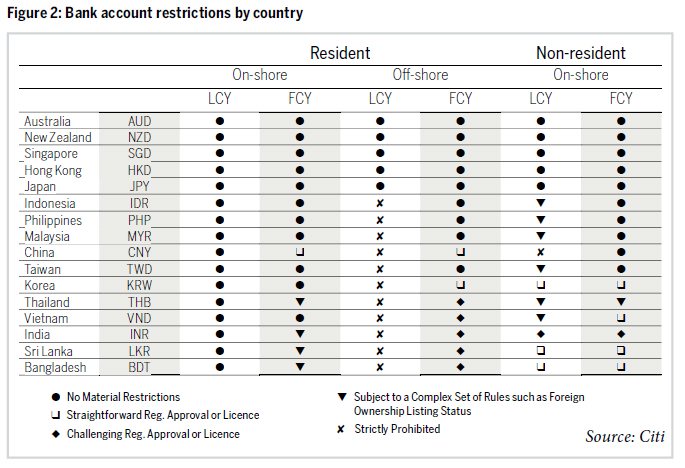
In south Korea, the cap on intercompany loans made by a resident to a non-resident entity under cash pooling management arrangements was increased from $10m to $30m in June 2008, subject to one-time approval by the Bank of Korea. In Malaysia, the foreign exchange administration rule was further liberalised in 2008, allowing foreign currency target balancing for liquidity management purposes for entities in the same group company, and allowing residents to lend local currency to non-residents to finance activities in the real estate sector. Figures 2, 3 and 4 give an indication of the restrictions that apply in major asian countries to bank accounts, domestic cash concentration and cross-border cash concentration.
Strengthening ties between the Middle East and Asia
1. Gulf money is pouring into Indian property and real estate.
2.Saudi Arabia ships over 1 million barrels of
oil a day to China.
3.Indian textile manufacturers export over 32% of their production
to the Middle East.
4.Chinese groups have set up operations in the Suez Economic
Zone (Egypt).
5. Middle East sovereign wealth funds are investing in Asian
economies.
6. Chalco has set up an aluminium smelter at Jazan Economic City, near
the Saudi border with Yemen.
7. Malaysia’s MMC is a partner in Jazan; Kuala
Lumpur has become a centre for Islamic finance.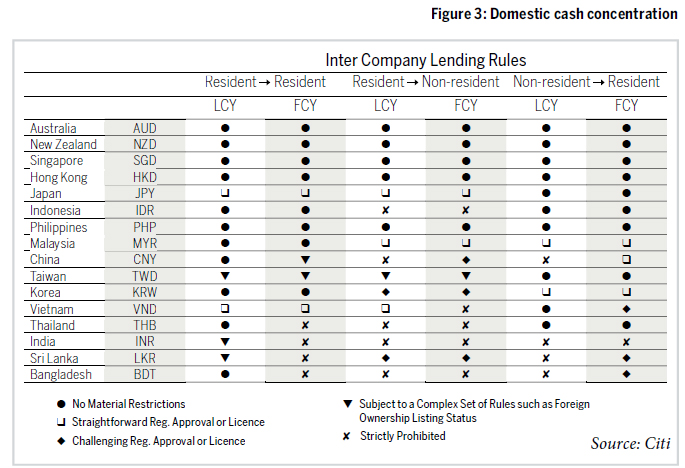
Sources:Business Week, World Bank, Zawya, AME Info.
Payment methods
For business-to-consumer and business-to-business, cheques and cash are the dominant methods of payment in roughly half of Asia, while electronic banking is embraced in the other half. However, for retail payments, the internet, mobile phones and cards are increasingly encroaching on cash throughout the region. For cross-border trade payments, letters of credit based on internationally recognised terms are widely used as
a way of reducing the risk of default.
Operating base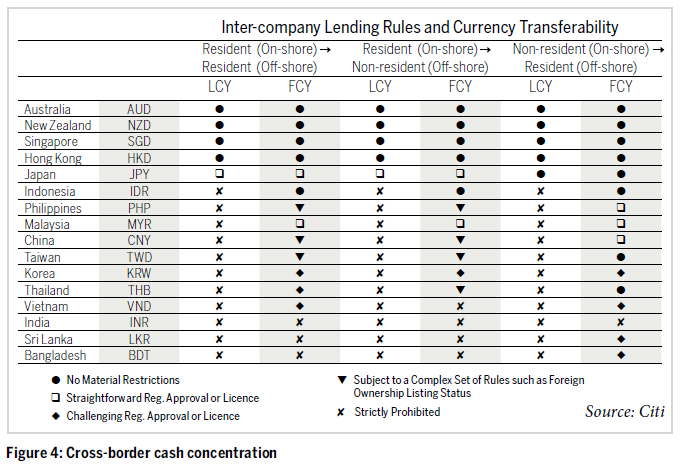
Middle Eastern energy companies with significant operations in Asia will need a regional treasury centre. The question is, where to locate it? The more developed, less regulated countries, such as Japan, Singapore and Hong Kong, will be the obvious choices, but a number of other factors will need to be considered, among them:
-
The availability of good banking facilities (Figure 2 gives an
indication of the bank account restrictions that apply in the main Asian
countries) -
Easy access to
major stock exchanges -
Professional expertise, especially on taxation and legal matters
-
The availability of trained personnel
-
A stable communication network
-
Liberalised capital markets
-
Political stability.Tax situation is also an important factor. Issues to consider:
-
The level of tax on the profits of the treasury centre
-
The withholding tax on interest, dividends, and royalties
-
Thin capitalisation rules
-
Stamp duty on establishing subsidiaries and issuing securities
-
Value added tax
-
Double tax treaty networks
Controlled Foreign Corporation (CFC) tax rules.
Once a regional treasury centre has been established, it must follow certain operational guidelines to ensure it is a success. Most
importantly, its policies must be approved by the board back home before they are executed. In addition, business units need to be educated about the new rules of the road; senior management must buy in to what is happening, and they should be asked to communicate developments to all relevant levels of their organisation.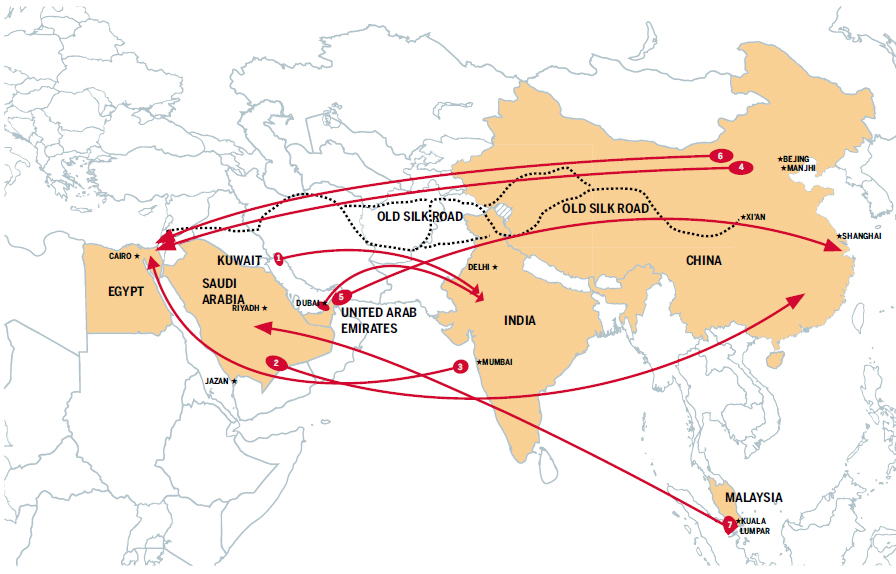
Another key to success is to minimise the number of banking relationships to create efficiency gains. These gains will come from using fewer, perhaps only one, banking platform; by building deeper, stronger banking relationships; and by making it easier to integrate the company’s treasury management and enterprise resource planning systems with bank systems.
Other useful tips include managing cultural change by involving the business in the decision-making process; ensuring the tax and legal teams provide the necessary support; and meeting regulators to obtain special concessions in important but restricted markets.
There is no doubt that Middle Eastern energy companies face significant treasury management challenges when operating in Asia. However, as long as they research the nature and scope of them, accept that some are surmountable and some are not, and set up effective local treasury operations, they will reap the rewards of doing business in this diverse and dynamic region.
Lance T. Kawaguchi is director and head of client
sales management, energy, power and chemicals, Middle East and Pakistan, Global
Transaction Services, Citi.
China’s banking system
Main areas of regulation and the regulatory bodies
- Central bank: People’s Bank of China (PBOC)
- Banking regulation: China Banking Regulatory Commission (CBRC)
- Foreign currency control: State Administration of Foreign Exchange (SA FE)
- Trade legislation: Ministry of Commerce (MOFCOM)
- Securities regulation: China Securities Regulatory Commission (CSR C).
Key features of banking regulation
- Controlled capital account
- Limited investment alternatives.
Local currency:
- Controls on interest rate
- Controls on physical cash flows
- Measures to ensure funds flows from corporate to individuals are based on genuine transactions.
Foreign currency:
- Controls on investment funds (capital) via capital account
- SA FE controls on foreign exchange and foreign funds flows
- Measures to ensure that foreign currency funds flows are based on genuine transactions
- Measures to ensure the correct tax treatment of foreign currency funds flows.
The payments and clearing system
The China National Advanced Payment System (CNAPS) is the electronic clearing system developed and implemented by the People’s Bank of China in 2003. CNAPS’ High Value Payment System (HVPS) is a Real-Time Gross Settlement (RTGS) system implemented in 2005, which has nationwide coverage (60,000-plus participating bank branches). CNAPS’ Bulk Electronic Payment System (BEPS) is used for small value Net Settlement Clearing and is being developed in several cities.Paper-based clearing will gradually decrease as HVPS and BEPS develop.
Rules on
cash repatriation and bank accounts Repatriating cash:
- Dividends can be remitted annually with no withholding tax (WHT)
- Royalties repatriated under contractual agreements are subject to WHT
- Fees paid for management services and technology are subject to WHT and SA FE approval
- Cross-border entrust loans are subject to SA FE approval.
Foreign currency accounts (corporate):
- Capital accounts used for capital injections
- Loan accounts used for foreign currency offshore inter-company loans and bank loans
- Basic settlement accounts used for trade and other transactions.
Renminbi (RMB) accounts:
- Basic account: one only allowed per
company, and all cash withdrawals must be from this account - General account: domestic
collections and payments, except for cash withdrawals.