

The scars left behind by the 2008 credit crunch and resulting financial crisis have barely faded and yet 2012 already looks as though it will be another highly challenging year for corporate treasurers. MARCUS HUGHES, business development director, Bottomline Technologies, looks at how they can cope
The world economy is once again on the verge of a new crisis as predictions of a double-dip recession look ever more likely to come true.
However, against the backdrop of doom and gloom, there is a ray of light that comes from how organisations use and manage their cash. Effective management of cash throughout its entire lifecycle can help steer a steady course through the choppy waters of the current financial crisis, and may even open up new opportunities for the forward-thinking corporate treasurer.
The role that the SWIFT network can play is critical to achieving a true cash lifecycle management (CLM) vision. With this approach, corporates and other non-bank financial institutions will benefit from lower costs, greater efficiencies, enhanced decision-making and reduced operational and financial risk.
Despite government promises that the banks will lend more, it is actually becoming more difficult for corporates to borrow. The tighter credit environment heightens financial risk and makes access to cash and the availability of working capital a critical factor for business survival.
Corporates are facing tougher lending criteria as banks become more stringent about whom they lend to, particularly as many foreign banks and niche lenders have retreated from the market. However, corporates that demonstrate strong management skills and can show that they are managing their cash along sound cash lifecycle management principles will find it easier to access credit.
There are a number of critical trends that have an impact on cash management, which in turn drive greater interest in how cash can be better managed throughout the organisation:
- increased globalisation: a global economy brings new customers, partners, competitors and cost models, including the opportunity to buy goods and services from lower-cost countries
- multi-banking: mitigating counterparty risk and the need to extend the global reach of the corporate treasurer make a multi-bank model more likely
- centralisation: this can deliver economies of scale and operational efficiencies alongside greater potential for forecasting, compliance and risk management
- elimination of paper based processes: the move from paper to electronic payments and e-invoicing offer major cost savings and much clearer visibility into your operations
- process automation: streamlining and automating processes delivers greater efficiencies, reduces costs and offers a high level of service to the process users
- standardisation: the requirement to connect to many other parties requires the use of standardised communications, which is crucial to the ability to inter-operate effectively.
Visibility and control
The importance of managing cash effectively and having visibility and control over cash cannot be overstated. For example, in the current climate careful timing over payments and receipts can be hugely beneficial, while the ability to minimise counterparty risk by rapidly moving cash to more stable banking partners is invaluable, especially in the event that the eurozone crisis deepens.
Cash lifecycle management, however, is about more than just managing payments, invoices and statements. It looks at the whole lifecycle of cash in the organisation, where it is now, what you will receive in the future and what you are going to spend.
The concept is that as cash moves through its lifecycle, different functionality is required to support the necessary actions.
The diagram below shows the end-to-end management of cash throughout its lifecycle. The execution task areas are indicated in dark blue, while the green end-to-end activities encompass the whole lifecycle. Linking them all together is a central communications “pipe”.
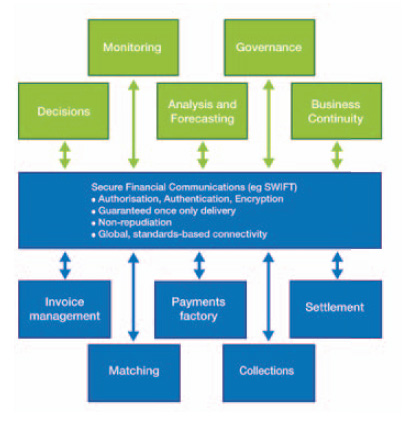
A model for Cash Lifecycle Management
The CLM model brings together IT solutions for a range of different cash-related activities. Instead of looking at each task in isolation, such as invoicing and payments, for example, all related cash management tasks must be viewed as part of the whole. This is a fundamental differentiator.
While improvements can be made and efficiencies achieved by implementing one component, such as a payments factory, consideration should be given to cash-related activities throughout the entire lifecycle, and across all participants such as departments, companies and partners.
Accurate intra-day assessments of liquidity must take into account all activities occurring across the cash management lifecycle, aggregated to give a centralised and comprehensive assessment. Cashflow forecasting similarly needs to be conscious of all cash-related activity.
It must also incorporate information from all the players in the cash lifecycle chain. This could be multiple banks of different sizes spread across the world, international payment service providers, correspondent banking accounts or a host of other sources of cash-related information.
Rules-based operations, where the decision-making during transaction execution is controlled by specific business-authored rules, deliver a range of highly desirable benefits. Business responsiveness and agility is improved through the ability to change operational execution by simply altering the rules that control it, and compliance management is improved since the “controls” that govern operations are gathered together in one place.
In order to ensure operations are functioning smoothly, monitoring is also required on an end-to-end basis, and business continuity measures must also apply across the lifecycle.
Governance spans areas such as risk mitigation and compliance management. As more of the cash management lifecycle is automated, it opens up new opportunities for financial crime. As a result, detection and prevention and anti-money laundering (AML) are now a key part of the process for minimising counterparty risk. Whilst AML used to be the focus for banks and non-bank financial institutions, it will increasingly become important to large payment intensive corporates in the future.
In addition, clear visibility of current operations combined with accurate cashflow forecasting enable companies to reduce liquidity risk.
Critical role of SWIFT
The cash lifecycle management model has at is heart the use of a secure and reliable financial messaging network such as SWIFT to handle inter-bank communications. It offers the required connectivity to all parties, between different environments and countries through the use of standards. It is reliable, secure and auditable, and offers non-repudiation and guaranteed delivery.
Connectivity can be achieved by hosting the infrastructure to connect directly to SWIFT or an increasingly common option is to use an outsourced bureau. Once the connectivity is in place, there will be opportunities to leverage the investment as SWIFT’s Electronic Bank Account Management, Trade Services Utility and e-invoicing initiatives for example, could provide added value in a cash lifecycle management model.
More than 9,700 organisations in 209 countries trust SWIFT every day to exchange millions of standardised financial messages. It’s long and distinguished history of providing and maintaining the SWIFT network, which allows customers to connect and exchange financial information securely and reliably, means that it is perfectly positioned to assist corporates with the communications aspect of a strong cash lifecycle management model.
Holistic view of cash
Taking a holistic view of cash and addressing its management needs at both the individual component level and across the entire lifecycle can bring significant benefits over and above those gained from managing cash in isolation.
Improved working capital management
This is both a key strategic goal and a direct outcome of better cash lifecycle management. It ensures that corporates have a real-time view of cash flow and, consequently, working capital. It goes beyond statement aggregation and provides the tools to track performance over time.
Visibility and control at the global and local level
The cash lifecycle management model delivers end-to-end visibility and control which allows management to delegate certain aspects of cash management to the local business units, safe in the knowledge that it is done within established guidelines.
Accurate cash flow forecasting
The greater visibility and control allow better governance and crucially it becomes possible to gain additional insight into the factors that are likely to affect your cash flow, enabling corporates to perform more accurate forecasting. This in turn allows corporates to quickly alter investment priorities for surplus cash if required.
Greater efficiency and reduced costs
It is important to note that it is the integrated nature of the cash lifecycle management model that drives the greatest benefits. This is not to underplay the benefits that can be gained from each component. However, true integration increases STP opportunities and delivers further efficiencies and cost reductions than can be achieved by any single component. By integrating the entire cash lifecycle you open up the potential for maximum process optimisation.
Mitigating risks
The greater visibility and control referred to above plays a significant role in reducing operational, financial and counterparty risk. The provision of an accurate and complete picture of cash ensures that treasury and management decision-making is more accurate, while the clarity across the entire process makes compliance management and achieving corporate governance easier. This clarity will be invaluable in the event of a full-blown financial crisis.
Partnership guidance
Bottomline’s cash lifecycle management should ideally be viewed as a best practice model for corporates to follow. Best practice absolutely requires managing cash across the full lifecycle, involving the effective integration of multiple systems and processes. However, the benefits on offer far outweigh the effort that is required to reach it.
The move towards more effective CLM does require some investment and it will involve changing established processes and potentially the corporate’s organisational culture as well. However, the return on investment can be significant and the effort required eased by outsourcing one or more components.
There are few vendors capable of delivering every single aspect of the cash lifecycle management model. The best way forward is to take a partnership approach with a vendor with the product range and strategic roadmap to deliver on this vision. Critically, when considering who to partner with, corporates should look for a company that already offers as many component solutions as possible and can leverage their own partnerships to fill in the gaps.
Outsourcing is an obvious route to achieve the goal for specific components such as invoice management or SWIFT connectivity. Whichever company you choose to partner with, it is vital to look for financial stability and long-term viability, as they will be critically important to your capacity to implement best practice around cash lifecycle management.”
Marcus Hughes is director of business development for Bottomline Technologies. He is an expert on transaction banking, and has more than 20 years experience helping some of the world’s largest banks and financial institutions devise and implement strategic initiatives for international cash management, trade finance and the financial supply chain.