
BY PAMELA ANN SMITH
If ‘cash is king’, given the global financial turmoil of the past 18 months, then so too is the need to cut costs. Many banks in the GCC which cater to corporates in the region are being squeezed, just at a time when they need to innovate and expand to ensure the loyalty of their clients and to meet tougher regulatory requirements. Outsourcing their cash management and trade finance activities to specialist providers may be one solution.
“Mid-tier banks are caught in that perfect storm,” comments Michael Burkie, Market Development Manager for Europe, the Middle East and Africa (EMEA ) at the Bank of New York Mellon. They are caught between the need for regulatory compliance and the lack of capital, facing ‘stresstests,’ he told Cash & Trade. “They have to divert funds from capital expansion for the front office, new branches, product development, technology to building up their capital. Yet if they can’t expand, their margins will drop.”
While the concerns of traditional corporate treasurers are “the nuts and bolts of banking,” he says that some banks have decided that “cash management and trade finance activities are support functions for their core business, rather than an integral part” of what they offer. Both processes, Burkie adds, “depend on a costly and closely monitored infrastructure.” Because many banks are experiencing “sub-optional returns” on these activities, “they are concluding that these functions are ideal for outsourcing to specialist providers.” Such a move, he says, would also “allow mid-tier banks to benefit from the economies of scale realised by the global banks.”
At present, investment in a state-of-theart cash management and trade finance system is extremely expensive, in terms of both development and operational costs. Average start-up costs for a full range of functions, including liquidity, payments, the supply chain, imports and exports in a real-time and multi-currency environment, can total some $200m. This includes the initial costs of technology, personnel and membership in the worldwide financial telecommunications network, SWIFT. Disaster recovery systems, together with back-up energy supplies and telecoms providers, can add even more.
Monthly running costs of up to $300,000 “are not unheard of,” observes Burkie. Still more overheads, and/or initial capital outlays, may be involved if the system needs to be updated. So, too, if it needs to respond to changes in the banking environment to take account of advances in technology or the need to comply with new multinational regulatory guidelines or additional anti-money-laundering procedures. “Given this,” Burkie maintains, the “proprietary working capital transaction services that banks offer to corporate clients may simply not be feasible for many at present, even though such a service is increasingly vital to meet the demands of corporates.”
So, what’s the answer? Investing in new technology platforms or in new cash management products may be advisable. But for those banks which need a full processing service, it may be necessary to turn to the large global providers, such as Citicorp, Deutsche Bank, J.P. Morgan Chase or HS BC or, as Burkie argues, to a specialist provider.
For mid-tier banks, a provider such as BNY Mellon, State Street Corporation or Chicago-based Northern Trust, may be more cost-effective, other bankers agree. These three, they add, have the advantage that they are long established world leaders, and highly respected, in their fields, which include custodial, securities and asset services.
Perhaps even more importantly, as other industry analysts and bankers have pointed out, is the fact that these three “do not compete” with their corporate bank clients. Unlike the global banks which often have branches in the very cities and regional financial centres in which their corporate banking customers are also operating, these specialists tend to operate in the GCC and in other parts of Europe, the Middle East and Africa through representative offices which concentrate on their corporate clients.
If these providers already service securities and assets, “why not payments?” asks Burkie. This doesn’t have to do with technology or product,” he emphasises. “It is simply cost-serving. It is the operating cost model. It helps it to change.”
If requested, the specialist service provider can also undertake all the backoffice functions typically performed by the corporate banks, such as multiple currency payments and trade document checking, as well as all other trade-related operations and custody management. This eliminates any potential competitive risks that might be incurred should these vital operations be turned over to a more generalised global bank which, as a result, would gain access to a corporate banks’ vital information on their own corporate clients.
So what are the cost benefits of using a specialist provider, a mid-tier bank might ask. Burkie is quick to respond. “The process not only relieves the outsourcing bank of the steep initial costs, it also turns a high, fixed cost into a much lower variable cost.” The business “can then be budgeted almost on a pay-as-you-use basis,” he adds, or on a “pay-as-your corporate-clientsuse basis.”
This will help with any challenges that may arise as a result of limited credit facilities, Burkie notes. “It also gives the outsourcing bank greater control and flexibility over the services it offers to its corporate clients, as well as better managing its revenue/expense ratio.” Once the outsourcing agreement is in place, he adds, “any further future expenses, such as new payment channels and regulatory adaptations also become the responsibility of the specialist service provider. This frees the outsourcing bank from potential future transaction risk, as well as system inoperability concerns.”
Unlike many other US banks and financial institutions, BNY Mellon, State Street and Northern Trust have quietly gone about their business, operating in the conservative and prudent way that they have for more than 100 years or, in the case of BNY Mellon, 225 years. It may not be glamourous, but it is cost-effective, and enduring. For corporate banks in the GCC, the fact that all three have opened up representative offices in Abu Dhabi and/or Dubai, as well as in the case of BNY Mellon Cairo, Beirut and Istanbul, promises a potential collaboration across borders that could benefit both the GCC and other mid-tier banks in the Middle East and North Africa.
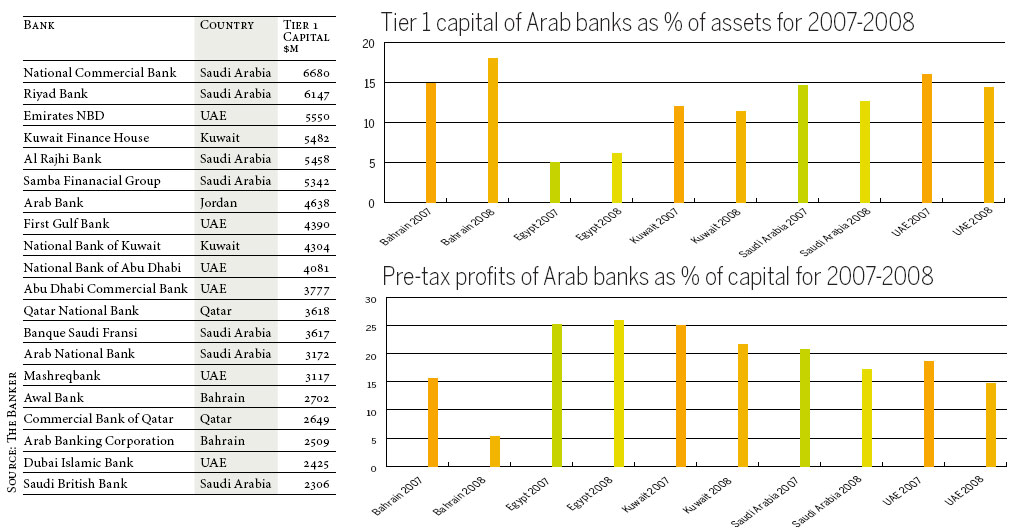
Bahrain banks lead in capital/asset ratios
Bahrain’s banking sector has the highest Tier 1 capital-to-assets ratio in the Middle East, according to figures compiled by The Banker and Cash & Trade. In 2008 the country scored an aggregate ratio of 17.96%, compared to 14.8% in 2007. This placed them ahead of second-ranking UAE, whose combined ratio stood at 14.32%, down by 1.63%. Saudi Arabia came in third, with a 2008 figure of 12.56%, followed by Kuwait with 11.41% and Egypt with 6.16%. Although Arab banks, including those in the GCC, have not been immune from the effects of the global financial crisis, banks in both Bahrain and in Egypt managed to increase their Tier 1 capital, a sharp contrast to the situation prevailing in the banking sectors of the US and Europe. In Bahrain’s case, the increase amounted to more than 3%, an impressive figure in the current international climate. Overall, banks in the GCC and in Egypt have ratios well above the Basel II requirements. In terms of the ratio of pre-tax profits to capital, Egypt scored the highest in 2008, with a figure of 25.92%, up almost 1% on 2007. Kuwait came in second, with a ratio of 21.69%, although this was down by more than three per cent compared to 2007. A slightly larger fall occurred in Saudi Arabia, where the 2008 ratio amounted to 17.15%, followed by the UAE with 14.68%, down almost four percentage points. In absolute terms, National Commercial Bank and Riyad Bank led the list of the Arab World’s top 20 for Tier 1 capital, with $6.7bn and $6.1bn respectively, followed by Emirates NBD with $5.6 billion. This put them just ahead of the Kuwait Finance House and Al Rajhi Bank. Virtually all of the top 20 came from the GCC, except for Amman-based Arab Bank, whose Tier 1 capital in 2008 reached $4.6bn.