

Dear Reader,
If there is a theme to this issue it is that the future is going to be challenging within the transaction banking space, especially, in one respect, for Gulf banks as they face a quickening in the pace of change.
As our Sibos review points out, few industries have been so impacted by the advent of online technology as cash management and transaction banking – and the swiftness of new developments shows little sign of slacking off.
This year’s global financial services conference, in Singapore in October, will provide a chance to take stock and consider what the past few years of frenetic development might mean for the way that banks operate in future: how they manage risks, the coming shape of their products and whether smaller institutions will be able to meet the technological and prudential standards driven steadily upwards by the big global banks and tough-minded regulators.
Our article points out that for banks based in the Gulf, these are key questions. The region’s major businesses are starting to expect sharper service and more innovatory financial products, with the agenda often being driven by more vigorous competition from foreign institutions deepening their footprint in the GCC economies.
In Cash & Trade’s regular corporate interviews, hopes for livelier service and more fresh thinking from local banks are a near constant refrain in the comments of senior financial executives at big Gulf companies. So the gauntlet has been thrown down by customers. The question is: how will the banks respond?
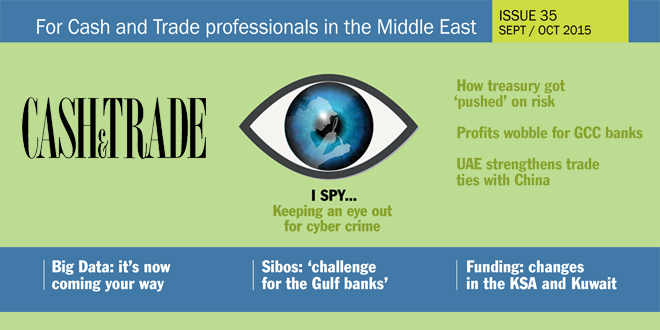
Perhaps, though, the biggest upcoming battle for banks as a whole is how to control the safe future of finance by taking on cyber-criminals, who are becoming smarter and more audacious. Of course, banks are fully aware of all these threats and have made strenuous efforts to combat cyber-crime at both policy and administrative level, and through the deployment of sophisticated technological controls. However, cyber-criminals themselves have specialist knowledge and insights into the latest technology which form the life-blood of their operations.
One suggestion is that “rather than fighting, one by one, the pervasive and shape-shifting wrongdoers, imagine if banks, regulators, innovators and other key industry players – all forces for good – came together to compare notes, without fear of competition or ridicule…In no time at all they would detect patterns, predict the next moves of ‘the enemy’, and help each other to innovate, strategise, and implement the tricks and tripwires necessary to prevent cybercrime”.
There’s no doubt that treasury has to cope at the sharp end when it comes to risk. Also in this edition we look at “the financial challenges that the ‘great recession’ imposed on many organisations, pushing treasury teams to the front and centre of corporate enterprise risk management (ERM) initiatives”.
While the biggest mandate for treasury post-2008 has been to deliver strategic value for the organisation as a whole, the need to establish controls and mitigate risk across the enterprise is also paramount.
One point made is that “when it comes to ERM, it would be best for treasurers to begin with risks that are within their team’s immediate responsibilities, starting with effective management of cash and liquidity”.
A further piece inside explores the concept of Big Data, and how it will be put to use in coming years. The term can signify anything from “more data, new kinds of data, real-time data or social media data to the technologies used to capture and analyse such information”.
Due to recent developments, Big Data is experiencing a surge in popularity and is receiving both further investigation and investment. In fact, as many enterprises embark on a digital transformation of their organisations, it has become clear that factoring in the capabilities to safely, accurately and productively store, process, manage, analyse and leverage data is a crucial element.
How big an issue is it? Well global investment in Big Data is expected to grow by 17 per cent CAGR to reach $76bn by the end of 2020.
Organisations are turning to the mass of information available to them to improve the customer experience, minimise risk, optimise operations, enhance business models and track market trends more accurately.