
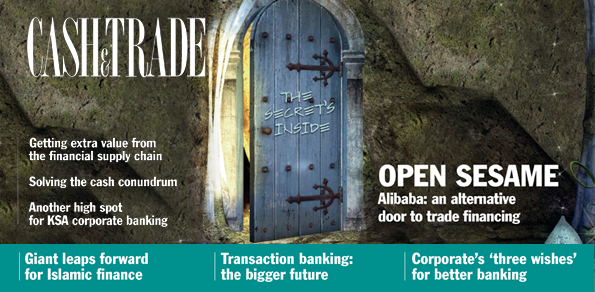

Dear Reader,
The future for transaction banking in MENA is looking good, according to a number of Middle Eastern bankers, who recently discussed how banks in the region could grow their share of global revenues by at least 25 per cent.
They were among 68 senior executives who gathered at iGTB’s client advisory event in Dubai to explore the challenges and opportunities on offer to transaction banking.
In this issue we provide an extensive report on this interactive forum – designed to encourage peer-to-peer dialogue – which sets out to explore how Middle Eastern banks could increase their share of global transaction banking revenues (which, estimates the Boston Consulting Group, are likely to hit $509bn by 2021).
Andrew England, a senior adviser at McKinsey and newly-appointed director and head of strategy, iGTB, said that transaction banking is undoubtedly enjoying a “gold rush” era thanks to surging global payment flows (related revenues are said to be due to reach $2.3 trillion by 2018), soaring inter and intra-emerging market trade, technological advancements and a renewed appreciation of the role of transaction banking in supporting the “real” economy.
Elsewhere in this edition, we look at “the liquidity paradox: what it means and how to solve it”.
According to another correspondent, economies are currently suffering from having too much liquidity in certain areas, while having too little in others. He says, “Banks, awash with cash, are reluctant to accept deposits; larger corporations are stockpiling cash but running out of options of where to place it; while small and medium-sized enterprises are often unable to access funding due to its cost and scarcity.”
Apparently, the issue has become so entrenched that it is beginning to have a material impact on business globally – “so much so that it has attracted the attention of politicians, desperate to kick-start their economies to provide employment and higher tax revenues”.
Having pointed out that central banks have used the various tools at their disposal (such as interest rates and quantitative easing), the author makes the point that “while these ideas are good in theory, the real problem is that they haven’t worked in practice”. His solution can be seen inside.
Still on the subject of banking, the choice of banks and their service offer available to Saudi businesses has been widening over recent years, but, according to a leading finance chief quoted in the latest of our series of exclusive interviews, not at a brisk enough pace. This, he says, has tended to foster a relatively conservative, risk-averse financial services sector in terms of the range of products offered to corporate clients in the Kingdom.
He feels that while Saudi Arabia’s banks tend to be of high quality and financially very strong, their attitude to business lending is cautious, whereas he would like to see “a more pro-active and aggressive approach adopted”.
Having said that, our latest Tajara Monitor reports that trade finance and corporate banking in the KSA had another record year in 2014 with total trade-related contingent liabilities and corporate assets, operating income and net income all registering new highs.
We also look at the fact that Islamic finance continues to hit new heights. In the past few months its global recognition has, says our update in this edition, “taken some giant leaps forward especially at the International Monetary Fund (IMF) and its associated World Bank, and in the Group of 20, which brings together the developed countries and the important emerging nations, including Saudi Arabia, Indonesia and Turkey.
It adds that a “potential game changer” could be the inclusion of Sukuk as a tool for infrastructure financing, which is on the official agenda of the G20 Summit to be held in Antalya, Turkey, in November.
Finally, in considering cross-border commercial business, we carry an intriguing article about China-based Alibaba, which has recently announced that it will offer trade financing solutions to clients conducting trade activity on its own platform. The Alibaba “e-Credit Line” offers financing when purchasing from Chinese suppliers, and whilst available in the US and the UK only at this moment, already promises “trade financing in minutes without paperwork”, with the support of a locally based account manager.